
Glad you asked! Puente needs winter items to help farm and nursery workers and their families endure an unusually cold winter. These include new sleeping bags, wool socks, and hoodies. For a full wish list, click here. Call or e-mail us with your donation questions at (650) 879-1691 ext. 116 or lvargas@mypuente.org.
29
Nov
2012
16 and legal: work permit changes Fernando’s life
The day that Fernando Macias-Morales received his work permit from the U.S. government’s Deferred Action for Childhood Arrivals (DACA) program was the day his life changed. Just ask his mother, Yanet.
“I couldn’t believe it. He was crying. I was crying,” she recalls.
Last summer, Puente undertook a major outreach effort to young people who could qualify for DACA. Puente partnered with Community Legal Services of East Palo Alto as well as private attorney, David Pasternak, to hold information sessions in Pescadero, and help people gather and complete the complicated paperwork – for free.
Under DACA, successful program applicants (all aged 30 or younger) are guaranteed the right to remain in the U.S for two years and work. The paperwork must be renewed every two years.
Fernando is one of 16 young people who applied for work permits under DACA this fall. So far, 10 of them have already been approved.
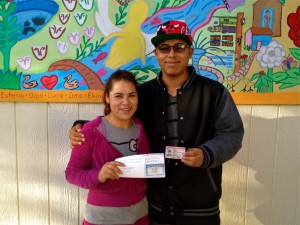
Yanet says Fernando knew he was taking a risk by applying to DACA, which would essentially inform immigration authorities that he had been in the U.S. for most of his life.
(Fernando was only two months old when his parents left Mexico. But his siblings are all legal residents, making his case particularly unfair.)
But the 16-year-old knew it was his only chance to live a normal life.
“In the past he used to say, ‘Whether I get an A or an F, it doesn’t matter. I’m not going to be able to go to college or get a driver’s license, or get into the profession I want,’” says Yanet. “Now he knows he’s working to get into college.”
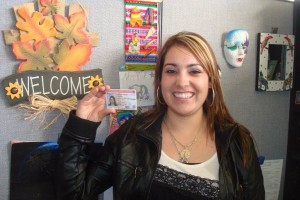
Yessenia Herrera won’t have to bum rides from friends to get to her community college classes from now on. She got her work permit in November and will apply for her California drivers’ license before the year is through.
The question on everyone’s minds is, what happens next? Analysts credit Latinos for propelling President Barack Obama to a second-term victory in many parts of the country. President Obama promised to renew DACA work permits when they expire in 2014, but he has also committed to comprehensive immigration reform.
Yanet Macias hopes her son will never again have to feel like an outsider.
“Since Obama granted Fernando a permit, maybe he’ll give him a green card. A lot can happen in two years,” she says.
To learn more about Puente’s efforts around DACA, contact Program Director Rita Mancera at (650) 879-1691 or rmancera@mypuente.org.
29
Nov
2012
High school at 37? Local mom is making it
Veronica Rivera never got past elementary school growing up. But if she had, she’d have been at the top of her class.
“She’s a really good student. She is always studying,” says Puente Program Director Rita Mancera, of Rivera.
Rivera is 37 and has four children, ranging from preschool to high school. In December 2011 she graduated from elementary school and in October, she graduated from middle school thanks to Puente – slightly ahead of her second-oldest son, who is in 8th grade.
Now, thanks to a scholarship from the Institute of Mexicans Abroad (IME) Becas, Rivera is preparing for high school – that is, she’s going to study for her GED, and will be tutored by volunteers at Puente.
“I like to study. The GED is hard work but I think I can do it,” says Rivera, who lives in La Honda.
Rivera is the first Puente student to complete her Plaza Comunitaria curriculum, a program Puente offers in concert with the National Institute for Adult Education in Mexico.
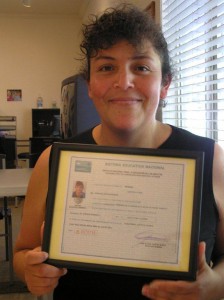
The literacy program, offered by a growing number of schools and organizations in the U.S., gives Mexican expatriates an opportunity to earn a “primaria” (elementary) and/or “secondaria” (middle school) degree.
It took Rivera less than a year and a half to complete the whole program, according to Mancera.
And why did she do it?
“I have one daughter in high school, in 11th grade, and one son in 8th grade,” she explains. “When they went to middle school they said, ‘Mom, can you help me do my homework?’ When they were in 3rd and 4th grade, I could help them. But when they went to 6th grade it was very difficult. I said. ‘I think I need to study again. I need to help my kids.”
Rivera never made it out of elementary school as a young girl, because she chose to stay home to care for her ailing mother and other siblings in Mexico.
But she scored very high on a diagnostic test administered to place Plaza Comunitaria students on the right academic track. Students don’t just learn to read – they learn other subjects by reading textbooks on health, social studies and Mexican history.
“That’s what I like about the system – it validates all the things you have already learned in life,” says Mancera, Puente’s Program Director.
Rivera (married name Carmona) is now known as the “Pride of Plaza Comunitaria.” She was even interviewed on 1010 AM, a Spanish-language Bay Area radio station, for a show called Hecho en California (“Made in California”).
Kassi Talbot, Puente’s Learning Center Associate, was the person who persuaded Rivera to enroll in classes in spite of her many commitments at home. Rivera studied with a Puente tutor two hours a week but did everything else on her own.
No one doubts Rivera will earn her GED in record time. The question is, what’s next?
“I think I’m going to college,” she says.
Funding for this project is provided in part by the Silicon Valley Community Foundation and Institute of Mexicans Abroad (IME) Becas. For more information about Plaza Comunitaria or other Puente literacy programs or to make a donation, contact Kassi Talbot at ktalbot@mypuente.org or (650) 879-1691 x 138.


