Why I give to Puente: Ruth Shavel’s donation addiction

‘Ruth Shavel, volunteer’ is a permanent nametag for Shavel. So much so that when she started collecting donated items for Puente schoolchildren, she didn’t even need to be told how to sort everything.

You might even say she’s addicted to giving.

Shavel, a Redwood City resident, has been volunteering since she was a teenager, putting trays on donuts to serve to injured World War II veterans with the Red Cross in Palo Alto.

“You had to be 16 to volunteer but I wasn’t – I was 14. I had to stay in the kitchen because I wasn’t supposed to be there,” says Shavel.

Later on, Shavel’s local school district benefited from her efforts as a volunteer both inside her children’s classrooms and as volunteer coordinator for the entire school district. Then she spent 15 years volunteering with Samaritan House of San Mateo, feeding homeless people.

So when a friend introduced Shavel to Puente last year, it was only natural that Shavel immediately decided to launch an all-out donation campaign to help collect school supplies for local students. She approached her local gym, a Curves franchise, about gathering the supplies. And a few months later, she showed up in Pescadero with an entire trunkful of paper, pencils, water bottles, calculators, crayons, folders, reusable lunch bags and backpacks.
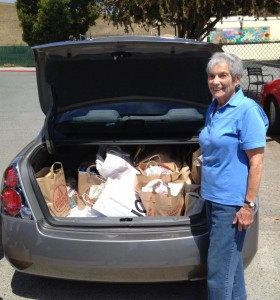
“I took the car and we filled the whole trunk. You couldn’t have gotten a toothpick in there. It was wonderful,” declares Shavel.

She hasn’t stopped there. Shavel now has another drive going for donated adult essentials – towels, soap bars, toothbrushes, jackets and the like, which Puente always keeps in stock to deliver to clients.

Puente needs your help this holiday season! Please see our wish list for children’s Christmas stocking-stuffers as well as gift bags for farm and nursery workers. New this year, Puente is raising $7,000 via a special campaign drive on Rally.org to give South Coast parents a gift card that will allow them to shop for their children.

“I think Puente is so far ahead of the other agencies I started with,” says Shavel. “They have a lot going on with a minimum amount of overhead. They have support up and down the coast. That’s the way to make a better life for these people who are here to help us.”


To learn more about donating to (and volunteering for) Puente, contact Abby Mohaupt at amohaupt@mypuente.org  or  click here

Stanford comes to Pescadero High

Pescadero youth get into Stanford – for high school credit

Stanford University is only an hour’s drive from Pescadero. But it can feel several lifetimes removed from the reality of the isolated South Coast, where most students graduate from Pescadero High with their sights set on community college or a public university.

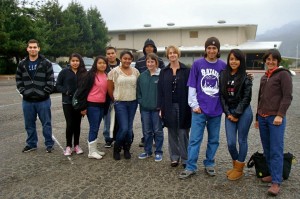
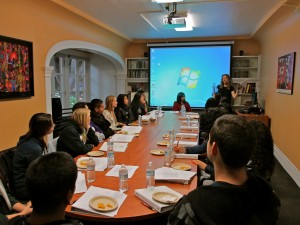
This year, ten highly motivated students from La Honda and Pescadero are taking classes at Stanford’s Center for Latin American Studies (CLAS) for credit – and getting a taste of real-world university academics, taught by Stanford professors.


The lucky students are enrolled in the Stanford Ambassadors Gateway Exchange Program, a community-based academic partnership that brings local students to the Stanford campus for twelve 3-hour classes over the course of a year.

“It’s hard to imagine what it’s like to be in college unless you’re there,” remarks Suzanne Abel, Academic Director for Puente. “We hope this will help add a challenging new intellectual element to our students’ high school learning experiences.  Being at Stanford, learning directly from professors in several fields, our students can open a personal door to the very real possibility of college.”

Thanks to a connection Abel forged between Stanford and the La Honda Pescadero Unified School District, Pescadero High School students were admitted to the program for the first time, joining a group of East Palo Alto Academy High School youth.  Abel hoped that at least a handful of students would sign up.  But direct recruitment by CLAS faculty and staff, as well as encouragement by high school Principal Pat Talbot and teachers, netted more than that – ten of them.

Best of all is the program itself, which is supported with Title VI funding from the US Department of Education. Students will be studying the entire Latin American hemisphere all year – from the standpoint of history and literature (fall), political economy (winter) and ecology and the environment (spring). Students are bussed in on Thursdays, dinner is provided, and classes are free.

The third quarter’s curriculum on ecology and the environment will be taught outdoors at Stanford’s Jasper Ridge Biological Preserve by Professor Rodolfo Dirzo, director of CLAS.  Students will learn about animals and plants of Latin America and what is occurring hemispherically with respect to climate change.

Many students have Latino origins, but Stanford officials “rightly assumed the youth would have some general sense of the region from their high school studies, but not necessarily detailed knowledge much beyond their own family roots,” says Abel.  “Besides, it’s a vast region, and there is a lot to know!”

Pescadero High School Principal Pat Talbot and Superintendent Amy Wooliever both jumped at the chance to send students to Stanford this year. So far, Talbot says the program has earned high marks from students.

“I always believe that anytime we can bring the outside world into this isolated district the better,” Talbot says. “I’m really happy that so many students decided to do this.”

Puente is just getting started in building a stronger relationship with Stanford, which also involves faculty whose research interests align with Puente’s needs. This past summer, four Puente youth were selected to participate in the Stanford College Prep program (through the Haas Center for Public Service, where Abel worked for many years).

Stanford medical school student Jessie Liu was a fellow with Puente this summer through the Office of Community Health (OCH), which envisions a long-term partnership in the community and has sent undergraduates to Puente before.

And Puente is in dialogue with the Stanford Office of Science Outreach about nominating one or two students from Pescadero to work in Stanford labs next summer through the RISE internship program (Raising Interest in Science and Engineering).

Día de los Muertos connects living to those who have died

Celebrating the dead, Puente style

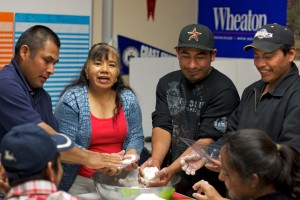
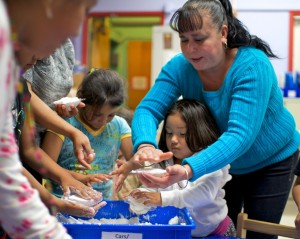
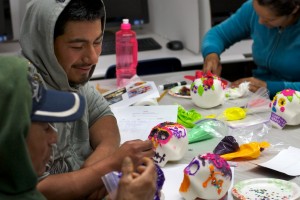
At Puente, preparing for Día de los Muertos (Day of the Dead) is anything but macabre. At a joyful workshop in early October, women’s hands (and a few men’s) reach into mixing bowls filled with a gooey blend of water, powdered sugar and meringue. Fingers push the sweet paste into molds the shape of skulls, small enough to fit in the palm of a hand.

The faux skulls are the centerpiece of a Día de los Muertos tradition that has been rooted in Mexico for centuries. Puente’s adult community looks forward to the holiday festivities all year.

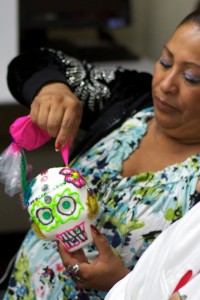
The sugar skulls are decorated with faux gems and paint, flowers and feathers. They will adorn a community altar, which will be displayed on November 1 at the final Pescadero Grown! Farmers’ Market of the season.

The Día de los Muertos program, run by Youth Program Associate Alejandra Ortega and part of the larger Madres Project funded through the Bella Vista Foundation, also involves making hundreds of beautiful paper flowers and artisanal Pan de Muerto (Bread of the Dead).

Día de los Muertos is a deeply personal ritual, and often an occasion to memorialize a loved one.

“I am dedicating this sugar skull to my parents and one of my brothers who died,” said Irma, a workshop participant who came in to decorate the sugar skull she made.

“My sugar skull is inspired by my grandma. She died of breast cancer last year,” said Gaby, who was there too.

When the altar goes on display, it will be laid with candles, art and photos commemorating the dead.

Día de los Muertos also has a strong element of nostalgia, and so in that way it is oddly comforting, says Rita Mancera, Program Director.

“It’s not just about death, it’s also about  loss – the things they had to leave in Mexico – the people, but also the life they left behind,” explains Mancera. “By celebrating it, it helped them remember those good times.”

The Madres Project helps combat maternal depression by connecting South Coast mothers with one another in a culturally resonant way. The idea is to create opportunities for group interactions that bring joy and a sense of community to those who may feel isolated. Bella Vista continues to award Puente $40,000 annually for Día de los Muertos, to stage the Christmas Posada and to provide counseling year-round.