Puente signs up first time voters

In spite of the hyper-blogged presidential debates and media-driven election controversies, many people on the South Coast do not feel connected to local, state or national elections.

This year, Puente was taking no chances. A month before the election, Puente staff was out in full force handing out voter registration forms. They targeted first-time voters: new citizens, and local youth who had just turned 18.

“One by one, we’re getting them all,” laughs Rita Mancera, Program Director for Puente.

Especially the young people.

“When someone votes at a young age, statistics show they’re going to keep voting later in life,” continues Mancera. “They may not understand much about politics, but I think it’s important that they know they have a voice. And I think this will help them feel more informed.”

Puente got Javier Morales to register to vote. He’ll be 19 in November, and this will be his first presidential election.

“I’ve always been kind of interested in politics. Especially this year, all the California propositions – how they want to take away the death penalty. And how they want to minimize penalties for ‘three-strikes,’” Morales says.

The life-long Pescadero resident enjoys watching the presidential debates and summarizing them for his friends. And he devoted a serious amount of attention to scrutinizing the two candidates for president.

“Especially now they we’re in a tough economy, I’ve been seeing how their budgets work out,” he says.

In spite of President Barack Obama’s much-vaunted appeal among youth voters in the 2008 election, numbers show that surprisingly few young people actually bothered to vote four years ago. It’s unclear how the diminished level of excitement for this year’s election will end up affecting young people’s voting choices this time around.
Puente Partners: Two legal nonprofits get the job done

Farm worker housing. Immigration. For years, Puente has had help defending the rights of South Coast residents, thanks to valuable partnerships with California Rural Legal Assistance, Inc. (CRLA) and Community Legal Services in East Palo Alto.

When local renters were suffering adverse effects from leaky, moldy farm worker housing, Puente connected with CRLA. Four tenants had the courage to bring a lawsuit against their landlord, forcing him to improve the housing stock. Thanks to CRLA, they also won substantial damages.

Puente introduced CRLA to a wide group of locals, and provided the clients and attorneys with a private place to talk, says Lisel Holdenried, a migrant staff attorney who handled the case.

“It would have been much more difficult if it weren’t for Puente,” says Holdenried. “They’re the first place in the community that our clients would go to for all kinds of services that we can’t provide. They’re the eyes and ears on the ground.”

More recently, Puente and CRLA have teamed up on a campaign to advocate for the county to make more affordable housing available to farm workers on the coast. They also want to make it easier for those who might have buildings to convert into farm worker rental housing, to do so.

Whole families have found a way to stay in the U.S. with legal papers, thanks to Puente’s client referrals to Community Legal Services in East Palo Alto. The two nonprofits have been collaborating for years on cases that Puente doesn’t have the legal expertise to solve.

Community Legal Services defended a Pescadero teen who was threatened with being deported to Mexico and separated from his family. It has filed visas for South Coast residents who came to the U.S. seeking asylum from persecution at home, and others who have been victims of rape.

Rosa Gomez, an immigration attorney with Community Services, says Puente’s referrals have been “incredibly valuable.”

“They’re in the community, and we’re in East Palo Alto. The coast in particular is isolated and really under-served,” says Gomez.

This fall, attorneys with Community Legal Services held several workshops at Puente’s headquarters to brief young people about applying for DACA, Deferred Action for Childhood Arrivals. Successful applicants will be able to legally work and drive in the U.S. for two years. Nearly 15 South Coast  youth have applied so far.

Puente gets schooled – in teaching ESL

Throw out that old textbook: Puente has adopted a new approach to teaching ESL to adult students, on the advice of one of the country’s most prominent experts on English-Spanish bilingualism.

Stanford Prof. Guadalupe Valdés has spent years documenting – and trying to solve – a problem most ESL educators try not to acknowledge: that -grammar-based ESL doesn’t teach students as much as it is hoped.

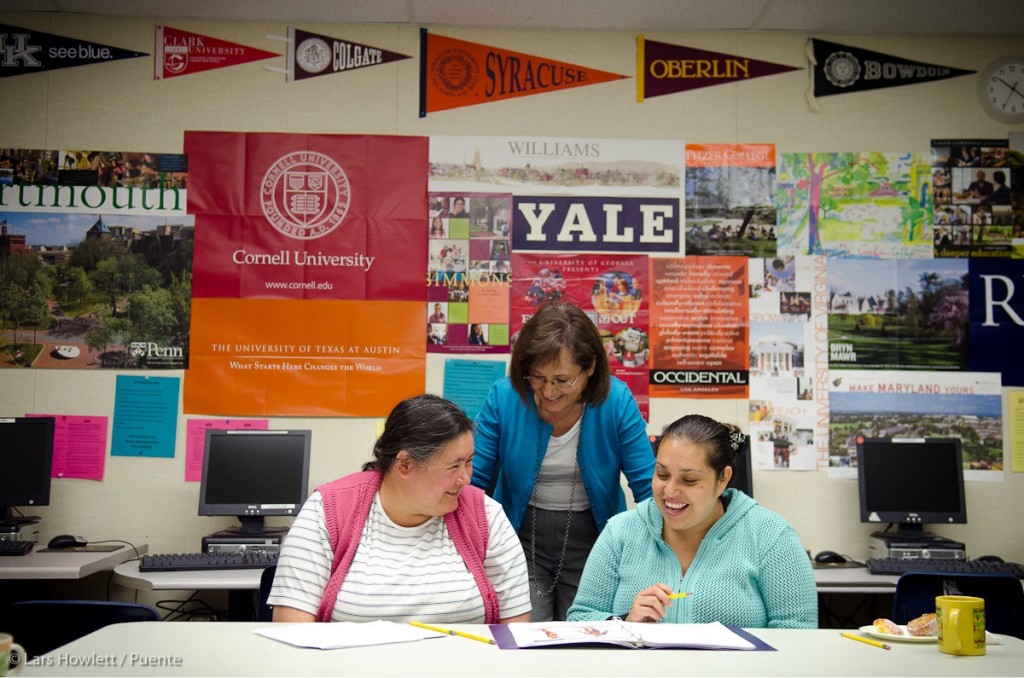
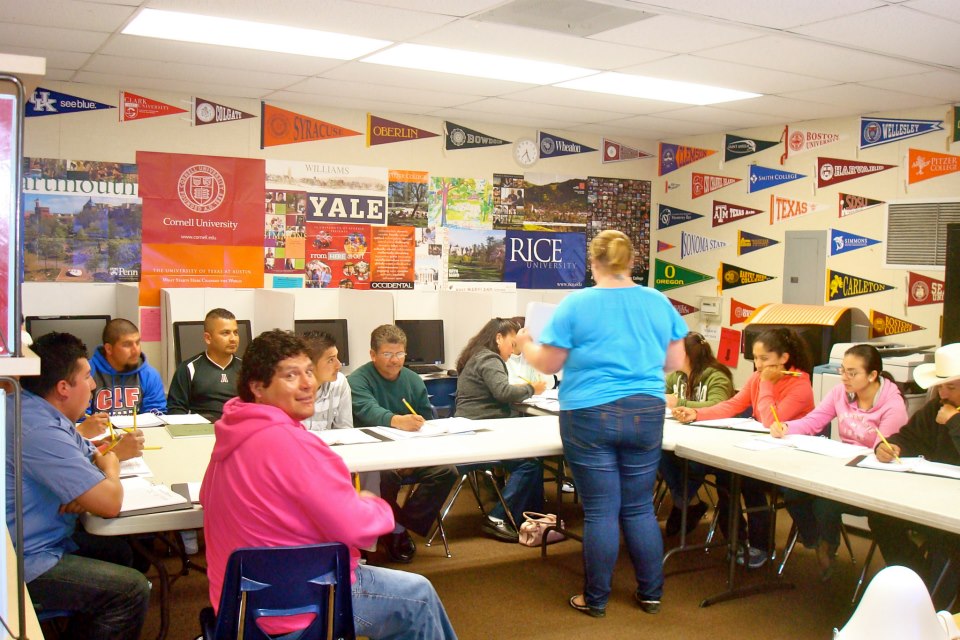
Guadalupe Valdes and ESL students

“The TESOL (Teaching English to Speakers of Other Languages) profession has generally agreed that it’s only native speakers who can teach English, and English can only be taught in English,” says Prof. Valdés. “The teacher doesn’t need to use the students’ language because they’re trying to teach them English. Prof. Valdés uses TESOL scholar Robert Phillipson’s catchy name for that kind of approach – ‘linguistic imperialism.’

In grammar-based approaches, students learn words and grammar, often without a clear understanding of what they’re repeating. And because the teacher doesn’t speak Spanish, he or she has no idea how much students are actually progressing.

Puente Academic Director, Suzanne Abel, and Executive Director, Kerry Lobel, invited Prof. Valdés to re-make Puente’s ESL curriculum this summer, using her techniques with a pilot class of adult learners. Puente offers the only available ESL classes to adults on the South Coast. Those who enroll are often parents of children who grew up in Pescadero and speak English as well as Spanish. The parents are locked away in linguistic isolation, even as their jobs often require them to know some English. They also can’t generally help their children with homework assignments. “People get so hung up in the correct way to speak English, that they never speak,” says Lobel.  “That really handicaps them in their ability to communicate with teachers.”

Prof. Valdés used the pilot class to work with Learning Center Associate, Kassi Talbot, to develop a set of instructional videos and a handbook for Puente’s use. Going forward, Puente will employ four ESL teachers who speak both Spanish AND English.

Kassi Talbot leads a class

“People who have never taken ESL were able to speak more quickly and confidently this summer,” notes Lobel. “It’s exciting to witness how much more engaging it was for the students.”

Rather than going sentence by sentence with a focus on grammar (“The cat sat on a fence,”) Puente ESL students in fall classes will learn useful phrases tailored to the context of their lives (“I’d like to order the ham sandwich.)Students will spend a lot of time developing listening comprehension meta-cognitive strategies by listening to how English is spoken  and watching specially recorded videos that reflect real-life situations and can be played back to develop their comprehension.

“We want them to be able to produce personal information, shop, return things, even complain, and understand what is said around them” says Prof. Valdés. And someday, perhaps even be able to help their children with their homework.