Literacy program gives adults a second chance at an education

Growing up in Mexico, school was never an option for Gabriel Echeverria. When he moved to Pescadero, the 66-year-old found work at a local flower nursery where literacy wasn’t an issue.

But today, Echeverria is well on his way to earning his elementary school certificate through Plaza Comunitaria, a program Puente offers in concert with the National Institute for Adult Education in Mexico.

The literacy program, offered by a growing number of schools and organizations in the U.S., gives expatriates an opportunity to earn a “primaria” (elementary) or “secondaria” (middle school) degree.

Three years into his studies with a tutor at Puente, Echeverria can read and write in Spanish. He staffs La Sala, Puente’s biweekly social hour for local fieldworkers; his job is to keep track of attendance, and inventory the supplies Puente donates. Echeverria says his new arithmetic skills have come in handy there. And importantly, Echeverria is one of Puente’s longest serving board members.
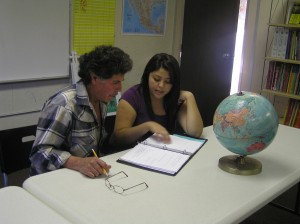
Gabriel Echeverria, with his tutor, Cristina Salgado

“I first joined Plaza Comunitaria to learn more words, but what I’ve gained from studying is bigger,” says Echeverria. “I feel more confident and more motivated. I feel important, like now I know how to do things.”

Because they’re starting from scratch, it can take years for students to earn a certificate of literacy from Plaza Comunitaria. Once they learn to read, they learn other subjects by reading textbooks on health, social studies and Mexican history.

Puente is tutoring eight students right now. Ostensibly, the goal of Plaza Comunitaria is to help Mexicans prepare for a better future if they return to Mexico. But people do it for all kinds of reasons, says Rita Mancera, program director for Puente.

“People have completed the program, but it doesn’t mean they get a better job or they get a raise – it’s because they want to be a role model for their children. It’s something they want do for their own sake, for their own dreams,” she says.

Kassi Talbot, Learning Center Assistant for Puente, would like to see more students enroll. She says Plaza Comunitaria not only changes a person’s self-image, it challenges stereotypes about Mexican immigrants.

I think helping them get an education is one the best things we can do,” she says.

Funding for the Project is provided in part by the Silicon Valley Community Foundaton and IME Becas. For more information about Plaza Comunitaria or other Puente literacy programs or to make a donation, contact Kassi Talbot at ktalbot@mypuente.org or (650) 879-1691 x 138.
Puente’s summer interns test-drive future careers

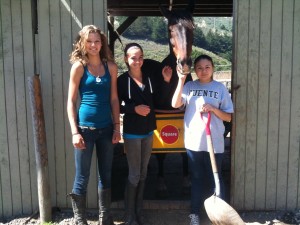
Gabriela Flores, along with Simone and Tallulah Froley of Half Moon Bay, and Bert, Square Peg’s beloved horse.

Gabriela Flores doesn’t consider herself a horse person. But she’s spending the summer with them. The 20-year-old is in awe of the horses she cares for at The Square Peg Foundation, a Half Moon Bay-based nonprofit that uses horsemanship to help kids with disabilities become emotionally stable and self-reliant.

Flores chose to do a summer internship at Square Peg because of her younger sister, a 15-year-old with Down syndrome. Flores wants to become a social worker, specializing in young clients with disabilities.

“The horses are a unique example of gentleness and power. They are so lovable and calm,” she says.

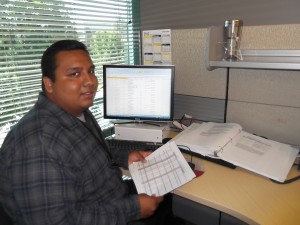
Hector Lopez

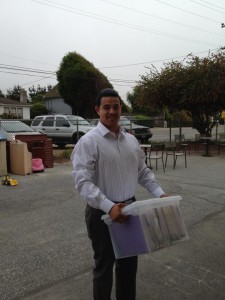
Flores is one of three young adults to benefit from Puente-sponsored internships this summer. The other two are Hector Lopez, who is interning at Symantec; and Omar Ortega, who is sharpening his accounting skills with At Your Nonprofit Service in Alameda, Calif.

Ortega, 18, helps file papers for the family-owned accounting business. A self-declared “money person,” Ortega is about to start college and is thinking about pursuing an accounting major. So far, he’s enjoying the work.

“I feel the responsibility of making sure that I satisfy the organizations that I’m working for – I kind of take that to heart. I always want to do the best that I can,” he says.

Omar Ortega

Summer internships aren’t like summer jobs. They’re not just about earning a wage. Ideally, they should reflect the interests or career goals of the young adults who sign up for Puente’s internship program, says Puente Executive Director Kerry Lobel.

“It’s not always easy to match the interest with the internship. This year we really worked with them to home their interests more carefully, and it’s been more rewarding for them.”

Take Ortega, who has had several jobs at Puente over the years. Puente staff members noticed his aptitude for numbers and assigned him the job of organizing Puente’s summer program at YMCA Camp Jones Gulch.

“Here, you get to do a lot of things, but you don’t always get to ‘own’ something,” says Lobel. “Omar did.”

Funding for the Project is provided, in part, by the TomKat Charitable Trust and San Mateo County’s Workforce Investment Board as well as individual donors. If you would like to offer an internship to south Coast youth, contact Rita Mancera at rmancera@mypuente.org, 650.879.1691 ext. 102.

Why I give to Puente: Janet Murphy, volunteer

Janet Murphy was a Puente volunteer on Day One, when Rev. Wendy Taylor founded an outreach effort to migrant farmworkers in Pescadero as an extension of the ministry at Pescadero Community Church.

That was over ten years ago. Puente has grown ten times over, and its programs touch nearly every aspect of the town’s cultural life – from schooling to nutrition.

But the center of Murphy’s world has never changed. It still revolves around ‘The Men Alone,’ as Rev. Taylor dubbed the workers who came to Pescadero without their families.

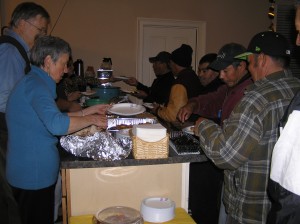
Murphy is the constant at La Sala, Puente’s longstanding gathering of mostly single men – farm and nursery workers —  who hang out, eat a hot home-cooked meal, play cards and laugh together twice a week at the Community Church. It’s their living room, a respite from hard labor a daily life that can be both stressful and grim.

“They’re here without their families. Their living quarters aren’t the greatest, and in the wintertime you get hot food and a stove and it’s warm,” says Murphy. They get things they wouldn’t get otherwise. And they get camaraderie.” Every newcomer to La Sala gets a welcome bag filled with toiletries, a towel, hoodie, sleeping bag and more. Puente will rustle up blankets if they need those, too.

Some of ‘The Men Alone’ call Murphy ‘La Maestra,’ a nickname left over from when she used to teach ESL at the church (before Puente started a similar program). Other men from La Sala call out to her in the street, or simply nod and smile. Of all the joys she’s experienced at La Sala over the years, it gives her the most pleasure to have those close relationships.

“I spend almost as much time with Mexican people as I do with non–Mexicans. I have families I’ve been visiting with for 20 years,” she says.

Murphy speaks Spanish well enough to form those connections (she likes to say she’s not bilingual, but ‘comfortable’). That makes her a fairly rare commodity in Pescadero: someone who represents the ‘Bridge’ that Puente stands for.

“My only wish is that there were more bridges. And that people understand what Puente is doing and participate more,” she says.

Murphy was recognized in 2011 with its Ray A. Nelson Award, Puente’s highest volunteer effort.

Puente is looking for volunteers! To learn more, contact Rita Mancera at rmancera@mypuente.org or (650) 879-1691 x 102. If you would like to donate items for welcome bags for newcomers, contact Kerry Lobel at klobel@mypuente.org or (650) 879-1691 x 144.