

Food stamps make farmers’ markets affordable for all

Puente has worked hard to make the point that buying fresh, local food on the coast should be as affordable as it is delicious. This summer, thanks to Puente’s initiative, shoppers in Pescadero and La Honda as well as at both Coastside Farmers’ Markets in Pacifica and Half Moon Bay will be able to sign up for food stamps and use their CalFresh (food stamp) benefits to buy anything in sight – fruit, fish, vegetables, eggs or meat. CalFresh purchases up to $10 will be doubled.

Shoppers at Pescadero Grown! Certified community farmer’s markets in Pescadero and La Honda already have their CalFresh purchases up to $10 doubled. But this year, Puente can announce another first: the La Honda Country Store is now the first market on the South Coast to accept CalFresh, and the only Coastside store to do so between Half Moon Bay and Santa Cruz.

That’s very good news for folks in La Honda who qualify for food stamps and are already struggling to pay for necessities, like gas and food, says Puente Executive Director Kerry Lobel.

“Up until now, people who wanted to use their food stamps to buy a quart of milk or some eggs would have had to schlep to Half Moon Bay. If you have to drive 25 or 50 miles to use your benefit, it’s not a benefit,” she says.

Very often people don’t recognize that Puente plays a role outside the South Coast. The corridor between Pacifica and Pescadero is well-traveled by locals, and now they can stop at any farmer’s market along the way and double their food purchases.
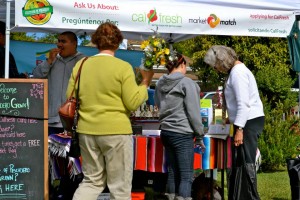
Puente has close ties with Erin Tormey, founder of the Coastside Farmers’ Markets. Puente was able to use its nonprofit tax status and good reputation to get some funding from the Human Services Agency of San Mateo County  to hire someone to enroll people in CalFresh right at the Coastside Farmers’ Markets.

Tormey says she is elated.

“There are dozens of senior citizens in this community who qualify for food stamps but don’t access the program. We have the opportunity to bring people into the program that won’t have to go to Redwood City to sign up,” she says.

That’s not all. Thanks to a grant from the California Farmers’ Market Consortium, qualified shoppers can double their money up to $10 for purchases of fruits, nuts and vegetables. A separate Puente program at the Pescadero and La Honda Farmers’ Markets gives discount “tokens” to shoppers, thanks to a fund built from generous community donations.

For details about Pescadero Grown! Farmers’ Markets and discounts, visit www.pescaderogrown.org. For details about the Coastside Farmers’ Markets, visit www.coastsidefarmersmarket.org.

Grant will fund home improvements

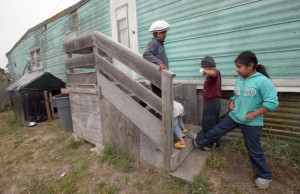
Here in San Mateo County, it’s no secret that many farmworker families live in housing that’s leaky, vermin-infested and unsafe. Trailers with holes in the walls. Overcrowded communal barracks with families of four wedged into a single bedroom.

Less well known is the fact that “substandard housing,” in official parlance, can lead directly to a host of chronic health conditions, like asthma. Cockroaches, rodents, mold and dust mites are all major asthma triggers, not to mention the presence of pesticides. That may help explain why a disproportionate number of Latinos living in rural California have been diagnosed with asthma.

Puente will take a small bite out of the problem thanks to a recent “Healthy Homes” grant from Gordon and Betty Moore Foundation. San Mateo County Supervisor Don Horsley obtained the $10,000 grant. “It’s to support the men and women who labor in our fields, to make their lives better,” he says.

In soliciting the funding, Horsley stated that “most of the housing farmworkers live in is subpar.”

The money, to be disbursed by Puente, will fund basic home improvements like dust mite-free mattress covers, dehumidifiers to counter the mold, insect traps and quick-fix expanding foam to fill holes and keep the vermin out.

Puente will also provide crucial supplies like smoke detectors, first aid kits, child-safe outlet plugs, dust mops and biodegradable cleaning products.

Karen Hackett, a San Mateo County Public Health Nurse who works with Puente, calls the grant “an important beginning.”

But she says the community needs more resources to address the underlying problems.

“We need to start talking about better housing, renovating and replacing housing structures that are deterioriating,” she says.

Hackett has witnessed the health effects of the farm labor lifestyle – the eczema and hand rashes from chemicals and harsh detergents; eye damage from spending days in field dust and fertilizers.

She’s seen how trash piles up next to housing because Pescadero has no pick-up service. The garbage breeds vermin and bacteria, and people end up living in close proximity to trash.

Other hazards lurk in farmworker housing. The Center for Environmental Research and Children’s Health at UC Berkeley has found a troubling link between pesticides in house dust and the health of children living on poor-quality farm labor housing in Salinas.

For more information, contact Puente Executive Director Kerry Lobel at klobel@mypuente.org or (650) 879-1691 x144.

Puente to hold meeting on new Obama immigration policy

Photo courtesy Christian Science Monitor

The Obama administration’s decision to stop deporting certain undocumented youth under the age of 30 is a life-changer for many young people Puente serves on the South Coast, says Kerry Lobel, executive director of Puente.

“People are totally overwhelmed with joy at the idea of it.”

While the announcement has yet to become official policy, parents have already come to Puente to ask what this could mean for their children’s lives. It can be hard to explain that this is not a path to citizenship, says Lobel; undocumented youth will be able to work legally, but they can’t vote or enjoy the many privileges and responsibilities that come with citizenship.

To explain the announcement and its implications, Puente has invited two attorneys Rosa Gomez from Community Legal Services in East Palo Alto and David Pasternak, Private Immigration Attorney and long time Puente supporter — to a community meeting on July 16 at 6 p.m., in the Pescadero Elementary School Multipurpose Room.

 Some South Coast students have already faced deportation. Other young people around the country have been sent back to their “home” countries, even if they’ve lived nearly all their lives in the U.S.

More than 700,000 undocumented students, including 150,000 high school students, could benefit from the new policy. Hector Martinez* is one of them. The 16-year-old has lived in Pescadero all his life. His mother brought him here from Mexico as a 1-year-old. Growing up, he realized he wouldn’t be able to get a legal job without a work permit. Getting a California driver’s license was also out of the question, since he’d need a valid Social Security number.

Someday, Martinez would like to be an auto mechanic.

“I don’t have a criminal record. I’ve been here my whole life,” says Martinez.

“It’s pretty much my goal to go to college and earn my citizenship.”

Lobel says she cried with relief when she heard the announcement.  It’s not a perfect solution – it doesn’t come close to the DREAM Act, for instance – but it does give local youth the chance to have productive lives without living in fear.

“Year after year, I see kids reaching that magic age of wanting to work and get driver’s licenses, and they’re completely left behind,” says Lobel. “Up until that point in high school there’s not difference – you’re just a kid. You reach that age and it’s like you’re becoming a criminal.”

 *Hector’s name has been changed. 

 For details about the community meeting, contact Puente Executive Director Kerry Lobel at klobel@mypuente.org or (650) 879-1691 x144.