
About This Project
Everyone deserves access to safe and healthy housing, but many farmworkers in our region live in housing that fails to meet basic living standards. This housing is often tied to employment, with farmworkers living in quarters provided by the farms where they work. That leaves many tenants reluctant to request basic improvements or repairs for fear of losing both homes and jobs.
Meanwhile, rental housing is scarce and prohibitively expensive. A 2014 report from San Mateo County showed the need for more than a thousand new units of farmworker housing; a 2024 report from the Silicon Valley Community Foundation showed the situation was not much improved. To afford the median rent on a two-bedroom apartment in San Mateo County, a worker would need to earn $63.81 an hour — that’s more than two and a half times the median wage for agricultural workers in California.
You can help make a difference in people’s lives by supporting Puente’s renovation of Casa de las Flores, an existing apartment building that needs urgent repairs.
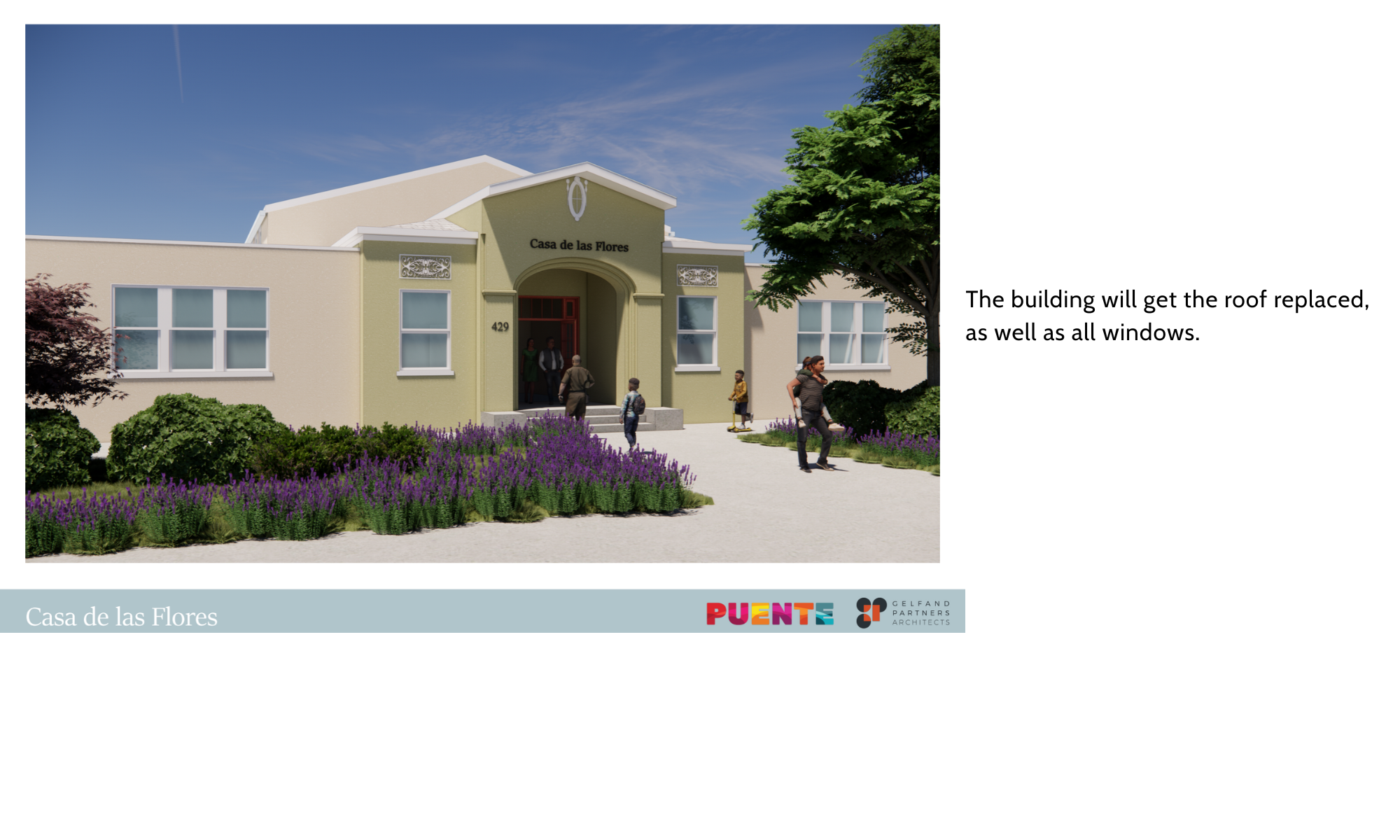
The Casa de las Flores (House of Flowers) renovation includes a complete overhaul of the facilities, including structural foundation work, upgrading HVAC, plumbing, electrical and fire suppression and water systems, walls, flooring and windows, appliances for the shared kitchens and bathrooms, new interiors and surrounding landscaping. We are also resurfacing and restriping the parking lot, which contains six spaces plus one ADA-compliant space, as well as improving the street parking.
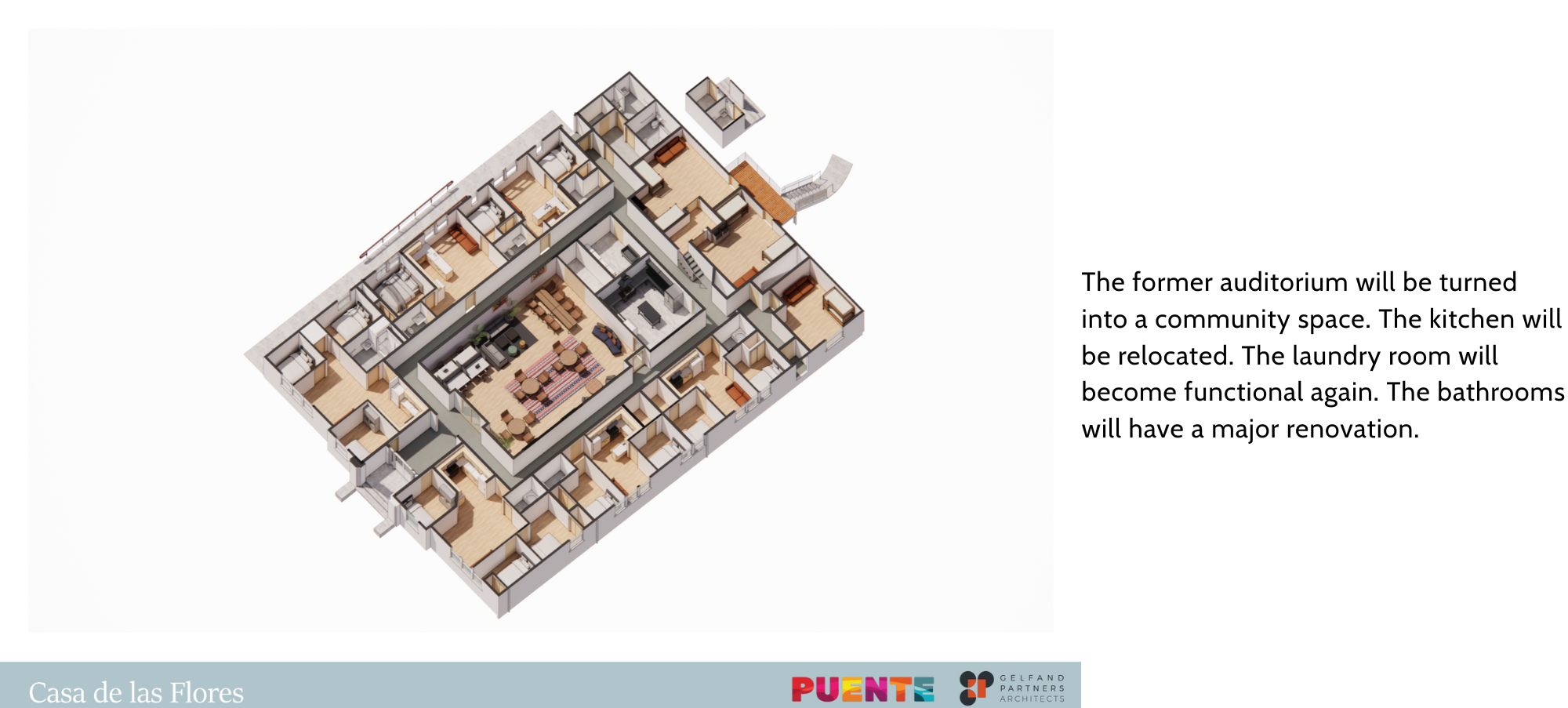
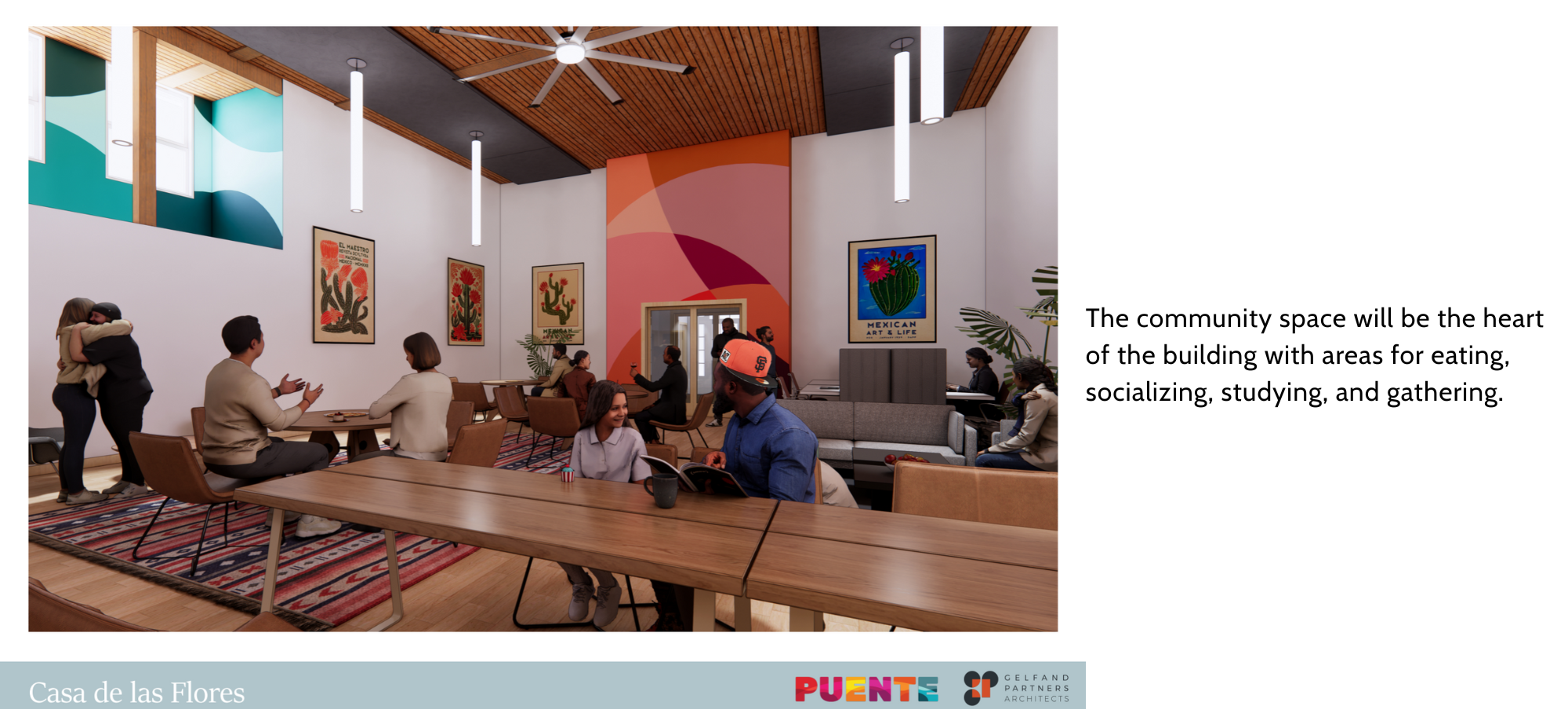
The central area of the building, which used to be old the high school auditorium, will become a communal space for tenants’ use that will include a kitchen, laundry facilities, and storage space, and a common living area that can be used for dining, socialization, recreation and other small gatherings. The plans include outdoor space in front of the building.
The current project will become a model for what we can do on the South Coast. Puente is raising $5 million to complete a full renovation of the building by the end of 2026.
We can’t get there without your help. Puente needs the support of foundations, corporations, community members, and donors to make this critical renovation possible.
Frequently Asked Questions
What is Casa de las Flores and why is Puente taking on this renovation project?
Casa de las Flores is a former high school built in 1925 that was converted to workforce apartments in the 1980s and which currently houses 26 tenants, most of them farmworkers and their families. Puente purchased the building in 2024 and now plans a $5 million renovation that will transform it into an attractive and modern place for farmworkers to call home.
Affordable housing for farmworkers is one of the most pressing problems on the South Coast of San Mateo County. Many of the farmworkers who are an integral part of our agricultural economy live in sub-standard living conditions.
How was the decision to purchase the property made?
Puente has almost 30 years of experience in meeting the needs of our community, and community members have consistently reported that housing is a vital need. Because of this community feedback and the information gathered in the 2019 Pescadero Equity Town Planning Initiative, Puente made housing a strategic priority and, in 2022, began looking at potential local properties. In 2023, when the opportunity to purchase this property became available, Puente formed a Housing Committee consisting of staff, board members, community members, and volunteers with expertise in affordable housing. The committee ultimately recommended to the Board of Directors that Puente go ahead with the purchase. The property is solely owned by Puente.
How and when was the land acquired?
Puente first considered the property purchase in the summer of 2023. After almost a year of negotiations, the purchase price was reduced from $5 million to $3 million. The property was purchased from a private farmer. The property includes 13.5 acres across two parcels, an 8,471 sq. ft. former school facility that was converted to farm labor housing in the 1980s, and 114,000 sq. ft. of greenhouses, and two storage buildings.
Where is the property located?
The property is a five-minute walk from Puente’s office in Pescadero and is located on a residential street half a mile from downtown. It is just over three miles to CA Highway 1, the coastal artery that connects Pescadero to Half Moon Bay, San Francisco, and Santa Cruz, and a 40-minute drive to US Highway 280 that runs through Silicon Valley on “the other side of the hill.”
How did Puente fund the purchase?
While the property negotiations were underway, Puente contacted several foundations for potential funding. Notably, Puente received a $2 million grant from Yield Giving, a charitable initiative of philanthropist MacKenzie Scott, and applied $1 million of this funding toward the property purchase. The other $1 million was directed toward operations and services for Puente’s existing five programs: community health, community mental health and wellness, education, community engagement and public policy, and community development.
The remaining $2 million of the cost of the property was funded through local foundations, including the Silicon Valley Community Foundation’s (SVCF’s) Donor Circle for Housing, the Chan Zuckerberg Initiative, US Bank, and the Valhalla Foundation, as well as individuals. Puente also held a community event that raised over $400,000 in contributions and sponsorships from the Grove Fund, Silicon Valley Community Foundation, Stanford Children’s Hospital, TomKat Foundation and several individual donors. Through generous support and careful planning, Puente was fortunate to not incur any debt in the purchase of the property.
What is the building currently being used for?
The building was originally built in 1925 as Pescadero Union High School, which later moved to its current location in 1960. The school building was used for a local farm’s operations for many years, and then repurposed as farmworker housing in the 1980’s. The greenhouses were used as a flower nursery until 2021, when the property was purchased by its last owner.
The current building houses 26 people, mostly farmworkers and their families, including six children under the age of 17 and a few college-aged students. Years of postponed maintenance and neglect have left the property in need of basic safety and structural repairs in order for the tenants to have a safe and dignified living situation.
When will construction start and how long will it last?
The plan is to conclude the permitting process and start work on the renovation in the first quarter of 2026. The estimated completion is approximately 6 to 12 months, depending on whether we decide to phase the project to account for challenges with temporary tenant relocations in our housing-constrained area. Ideally, the project will be completed by December 2026.
Will the renovated units be for families or single accommodations?
Housing units at the property comprise 4 dorm style apartments and 6 family units.
Dorm apartments consist of single-room bedrooms with a closet; these tenants share a bathroom down the hall and have access to a communal kitchen. These units range from 101 sq. ft. to 290 sq. ft.
One family unit will be renovated as a one-bedroom, and the other five will all have two bedrooms, with a separate living area. All family units have a private bathroom and private kitchen within each unit. The family units range from 284 sq. ft. to 516 sq. ft.
Currently, there are 26 people living in the building. There are 7 single adults in the 4 dorm apartments, and a total of 19 people living across the 6 family units. The renovation does not change the footprint or basic floorplan of the building. The number of family units will remain the same. One dorm apartment will be added as a result of the renovation work.
Who is leading the project?
The renovation work is being led by a Housing Committee that includes:
Gabriel Garcia, Chair of the Board; Martine Habib, Board Member; Arlae Alston, Director of Programs; Corina Rodriguez, Community Development Director; Stephanie Perez, Project Specialist; Mark Velligan, Community Member and former Board Member; Rich Gross, Retired Affordable Housing Expert; Irma Mitton, Volunteer Sustainability Expert; and Rita Mancera, Executive Director. This committee is supported by the Rural California Assistance Corporation, Gelfand Architects and several contractors.
The fundraising efforts are being supported by a Casa de las Flores Renovation Fund Committee that includes:
Gabriel Garcia, Chair of the Board; Rich Gross, Retired Affordable Housing Expert; Kwok Lau, Volunteer; Norma Alvarez, Board Member; Kerry Lobel, Volunteer and former Executive Director of Puente de la Costa Sur; Alejandra Ortega, Fund Development Director; Mark Wallace, Grants Manager; and Rita Mancera, Executive Director.
For more information, please contact:
Alejandra Ortega, Fund Development Director
(650)262-4100


