Puente and La Honda-Pescadero Unified School District roll out free COVID-19 testing for all

Puente and the La Honda Pescadero Unified School District have helped to bring free COVID testing to the South Coast
Puente y el Distrito Escolar Unificado La Honda Pescadero han ayudado a llevar las pruebas de COVID gratuitas a la costa sur

For Puente, the earliest months of the pandemic were spent coping with a whirlwind of community needs. New systems of support emerged quickly, from weekly food distribution events to cutting checks to replace lost wages, provide rent assistance and pay for utilities. Early on,  Puente started advocating to bring COVID-19 community testing to Pescadero.

Puente Executive Director Rita Mancera started asking San Mateo County for its support.

“It felt like an emergency to bring testing to town  because people were still working and living pretty closely. We were already giving out PPE (personal protective equipment), but we knew that wasn’t enough. We knew that this thing was spreading quickly. So, we felt that testing was the next big step,” says Arlae Alston, Program Director for Puente.

The first county-run local tests happened on May 29, with the support of Puente staff. For two days, testing focused on farms and ranches where farm workers and their families live and work together in tight quarters.

Puente continued to focus on testing at farms throughout the summer of 2020, and also helped register people for COVID-19 testing appointments in Half Moon Bay. Locally, the low infection rates were a semi-hopeful sign.

But the need for regular, community-wide testing took on an even stronger urgency after the CZU Lightning Complex Fire prompted a mandatory evacuation order which forced most of the community from their homes and into hotels and campgrounds for weeks in August and September. Families now faced potential exposure to the virus in their new, improvised lives. By the time everyone came home again, the overall number of positive cases climbed above ten for the first time—and kept climbing.

“Some people might think that 13 or 14 cases is not a big surge. But in a small community where you have a lot of shared housing, it can be really devastating,” says Amy Wooliever, Superintendent for the La Honda-Pescadero Unified School District (LHPUSD).

Before the fires, says Wooliever, “We felt like we were in a little bit of a rural bubble.” But afterwards, “We knew that bubble had been popped.”

Wooliever and her staff were very concerned about the school district’s staff and students. Grades 1–6 were set up in small outdoor learning pods throughout the South Coast, the better to address severe internet access problems and keep interactions limited with appropriate social distance. But she really had no way of knowing whether teachers, parents or children were COVID-positive unless they showed symptoms and drove to a testing site in Half Moon Bay—not a popular option, and certainly not consistent with lockdown protocols.

“Since our schools are a reflection of our community, I knew we need to get a handle on the spread in the community if we had a hope of addressing the spread in the school system,” she says.

After some back-and-forth, the county found a way to support a local “self-testing” protocol run by Puente and school district volunteers. Wooliever and her staff joined forces with Puente to set up the first free community-wide testing event at the school district offices in Pescadero, on September 9. It drew 97 people. Successive monthly testing events at the high school have drawn nearly 200 participants at a time, as locals become more aware of the service—and as concern over spiking community transmission levels has grown across California.

“It’s been super successful. It’s an expansion of partnership with Puente. And we so appreciated the county’s willingness to partner with the school district,” says Wooliever. At the events, a county nurse and three other Spanish-English bilingual support staff from the San Mateo County Health Department help explain the testing protocol and answer questions at the monthly community testing events. Puente handles the pre-registration and helps with day-of logistics, alongside a team of school district teachers and staff—including Wooliever.

“It was a brilliant move because it freed up county resources that would not otherwise find their way to Pescadero—and showed the commitment on the county’s part,” she adds.

But what happens when someone tests positive for COVID-19? If that person is living in farm worker housing with bunk beds or other communal spaces, the risk of transmission is high. But there are very limited places for people to sequester in Pescadero, especially for those of limited means.

Puente has done its best to help where it can, says Ophelie Vico, Community Health Specialist for Puente.

“We had a few cases in the farms. Right away the farm managers contacted us, and we were able to test them and find them housing that was separate from where they usually lived, outside their communal housing. This happened in a matter of hours,” she says.

Alston adds that in some cases, workers were able to isolate at home, but that is not always the case. “One man did sleep in his car,” she recalls.

A massive logistical challenge

The scale of the testing events—which happened twice in January—is phenomenal. Puente staff work intensively to prepare for and execute up to 200 tests in a few short hours.

It all starts with pre-registration, which Puente facilitates on its website and through social media, as well as offering appointments by phone. There are three forms to fill out, including a consent form and an insurance form (participants’ insurance plans cover the entire cost of testing, and if they do not have a form of health insurance, the cost is covered by the county).

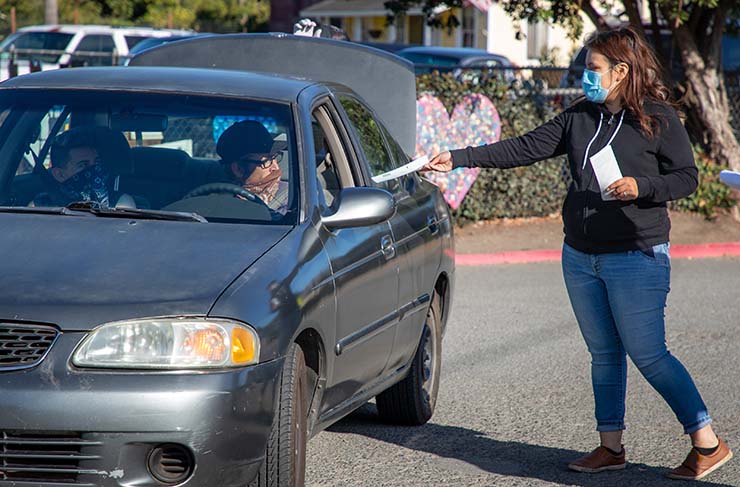
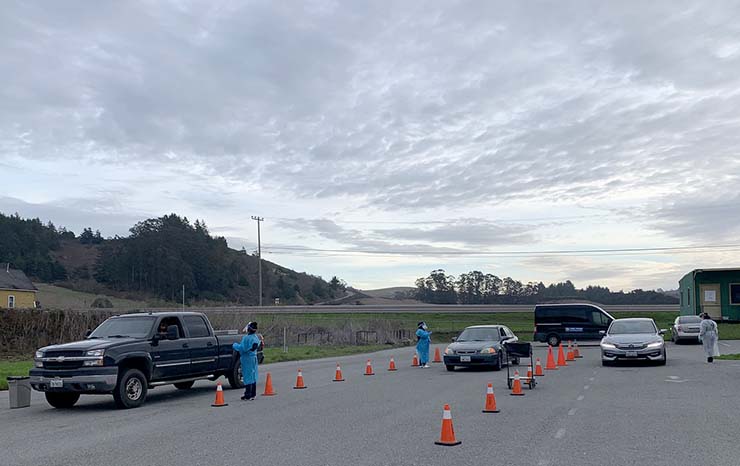
On testing days, a line of cars often stretches all the way from the school district back to Cloverdale Road. It takes five or six school district staff, four Puente staff, and up to three county workers to handle the work of directing traffic, checking people in, distributing the self-administered mouth swabs, explaining how to do the tests, and making sure the swab samples are securely labeled and collected.

“There so many steps that happen, you don’t even realize when you’re doing it all,” laughs Vico, who has helped manage all of Puente’s testing events since September.

Test-takers are instructed to roll down their car windows just a bit so that a community health promoter, wearing gloves, mask and face shield, can hand them the test kit bag attached to a stick to ensure they are six feet away. The community health promoter explains in English or Spanish to swab their mouth for 20 seconds, put the swab in a tube with special solution, cap it, shake it up and seal it inside another bag along with a label that the lab can scan to get all their information.

It can all take up to four hours, or as long as is necessary to test everyone in line that day.

But the work doesn’t stop there. Immediately following the testing events, a Puente staff member gathers all the tests, drives to office, prints out a specialized package manifest and shipping label, and drives all the way to the UPS store in Half Moon Bay—a 30-minute trip. The samples are then shipped overnight by air to Curative Inc., a lab in Los Angeles that contracts with San Mateo County. Results are available within 24 to 72 hours.

Education, outreach build trust

Many Pescadero-area Latino residents are farm and nursery workers, deemed essential workers since the start of the pandemic. But that does not mean they have been afforded protections equal to their status. Nationally, front-line agricultural, retail and service workers of color have all borne the brunt of the pandemic on their families and communities.

Across the country, Black, Latino and Hispanic Americans are dying at a disproportionately higher rate of COVID-19—almost three times as high—as their white counterparts, according to updated information from the CDC. Native American and Pacific Islander communities across the U.S. have been similarly affected out of proportion to their relative population size. Systemic burdens on these communities have exposed the very different conditions that led to this outcome—from a higher risk of exposure, to scarce access to testing, to inadequate access to preventative care, to living conditions that exacerbate the spread of the disease.

These disparities play out to a troubling degree here in California, where the death rate for Latinos is 21% higher than statewide. For Pacific Islanders it is 26% higher than statewide, and for Black people it is 14% higher than statewide (according to the state’s own health equity tracker).

Fortunately, the South Coast has a strong capacity for self-advocacy, thanks to the residents and community groups that regularly campaign for an equal standard of care. Longstanding partnerships between Puente, the school district and the county made it possible to respond quickly and appropriately to the crisis.

The other big reason that testing could succeed was trust. The high level of trust in Puente made it easier to bring even skeptical participants around to the importance of getting a COVID-19 test, according to Alston.

“At the beginning, there were different theories going around about testing, like conspiracy theories,” she recalls. “I think the big piece was really educating the community around not only testing, but what is COVID?”

In talking with participants, Puente staff realized that a key missing ingredient was education. They countered misinformation by explaining how the virus behaves, how it is spread, and how important it is to wear a mask and wash hands regularly. Vico credits farm owners who persuaded their workers to get tested early on, and got them registered with Puente.

Puente also held a Facebook Live event with a local doctor who talked about COVID-19 and answered people’s questions. Vico has designed colorful flyers with essential information about preventing the spread of the coronavirus at home and in the field, and these have been posted at ranches and on social media.

Some of those materials and messages were based on language being used by nonprofits doing similar work in Mexico. Many of Puente’s Latino participants are from Mexico. “I wanted this education to be culturally relevant. I wanted to be able to share what they’re hearing through their family members that live in Mexico. I wanted to make those connections,” says Alston.

It worked. Participants’ attitudes have shifted markedly from avoidance or skepticism, to actively calling Puente to request help with testing. Puente continues to distribute free PPE, and it offers on-call testing for individuals who think they have symptoms.

Honoring basic needs

Discussions of “working from home” were simply never a reality for a vast number of Puente participants, who have been working outside the home throughout the pandemic. Nationally, workers with earnings in the lowest percentile have been the least likely to work from home, and paid sick leave is rarely afforded to agricultural workers. Neither the state of California nor the U.S. have standards on paid sick leave. As a result, there is a concern that workers are forced to shrug off their symptoms rather than risk losing income, potentially spreading the coronavirus even further.

Puente stepped in early on to provide ongoing rental assistance, food assistance and wage assistance for workers who lost income because of the lockdown. Since then, it has done the same for participants who test positive for COVID-19. “We have brought them groceries once a week, we have picked up their medications at the pharmacy, we have given them rental assistance, and if they lost wages, we have been able to provide a check for them,” says Alston.

In March, Puente launched a grocery and medication support program for residents over the age of 55. To date, Puente has spent more than $8,000 on that program. It has provided $57,685 in rental assistance to keep participants from the threat of eviction. Puente has also disbursed nearly $5,000 in direct financial assistance for lost wages and utilities.

Puente also provided direct financial relief to local families ineligible to obtain federal COVID relief checks under the CARES act due to their immigration status.

This sent a very deliberate message to everyone: if you get sick, it’s okay to stop and heal. Your needs will be met.

“I think the piece that we have done well is making sure that people have what they need to be able to ride this humongous wave. When you know that your basic needs are being met, you’re more likely to follow the rules together as a community,” Alston adds.

One hopeful change on the horizon is that teachers and agricultural workers are now included in the priority tier of the Phase 1B vaccine distribution in California. This means that a COVID-19 vaccine should be available to these groups very soon. And as a result, much of the overlapping communities on the South Coast—such as the school district’s teachers, support staff and families with children—will get some protection from the virus. Puente and the school district are in talks with San Mateo County officials about a local vaccine rollout, which Puente would manage.


Puente y el Distrito Escolar Unificado de La Honda-Pescadero implementan pruebas de COVID-19 gratuitas para la comunidad 

Para Puente, los primeros meses de la pandemia los pasó apoyando con un torbellino de necesidades de la comunidad. Rápidamente surgieron nuevos sistemas de apoyo, desde eventos semanales de distribución de alimentos hasta recortes de cheques para reemplazar los salarios perdidos, proporcionar asistencia para el alquiler y pagar los servicios públicos. Desde el principio, Puente también comenzó a abogar para llevar las pruebas de COVID-19 a la comunidad de Pescadero. 

La Directora Ejecutiva de Puente, Rita Mancera, comenzó a pedir apoyo al condado de San Mateo. 

“Se sintió como una emergencia traer las pruebas a la ciudad, porque la gente todavía trabajaba y vivía bastante cerca. Ya estábamos repartiendo PPE (equipo de protección personal), pero sabíamos que no era suficiente. Sabíamos que esto se estaba extendiendo rápidamente. Entonces, sentimos que las pruebas eran el siguiente gran paso”, dice Arlae Alston, Directora de Programas de Puente. 

Las primeras pruebas locales realizadas por el condado se realizaron el 29 de mayo, con el apoyo del personal de Puente. Durante dos días, las pruebas se centraron en granjas y ranchos donde los trabajadores agrícolas y sus familias viven y trabajan juntos en espacios reducidos. 

Puente continuó enfocándose en las pruebas en granjas durante el verano de 2020 y también ayudó a registrar personas para las citas de prueba de COVID-19 en Half Moon Bay. A nivel local, las bajas tasas de infección eran una señal de esperanza. 

Pero la necesidad de realizar pruebas periódicas en toda la comunidad adquirió una urgencia aún mayor después de que el incendio del complejo relámpago CZU provocó una orden de evacuación obligatoria que obligó a la mayoría de la comunidad a abandonar sus hogares y trasladarse a hoteles y campamentos durante semanas en agosto y septiembre. Las familias ahora enfrentaban una posible exposición al virus en sus vidas nuevas e improvisadas. Para cuando los residentes volvieron a casa, el número total de casos positivos superó los diez por primera vez y siguió aumentando.  

“Algunas personas pueden pensar que 13 o 14 casos podrían no ser un gran aumento. Pero en una comunidad pequeña donde tienes muchas viviendas compartidas, puede ser realmente devastador”, dice Amy Wooliever, Superintendente del Distrito Escolar Unificado de La Honda-Pescadero (LHPUSD). 

Antes de los incendios, dice Wooliever, “nos sentíamos como si estuviéramos en una pequeña burbuja rural”. Pero luego, “Sabíamos que esa burbuja se había roto”. 

Wooliever y su personal estaban muy preocupados por el personal y los estudiantes del distrito escolar. Los grados 1 a 6 se organizaron en pequeños módulos de aprendizaje al aire libre en toda la costa sur, lo mejor para abordar problemas graves de acceso a Internet y mantener las interacciones limitadas con una distancia social adecuada. Pero realmente no tenía forma de saber si los maestros, padres o niños eran COVID positivos a menos que mostraran síntomas y condujeran a un sitio de prueba en Half Moon Bay, una opción que no es popular y ciertamente no es consistente con los protocolos de cierre. 

“Dado que nuestras escuelas son un reflejo de nuestra comunidad, sabía que teníamos que controlar la propagación en la comunidad si teníamos la esperanza de abordar la propagación en el sistema escolar”, dice ella. 

Después de algunos intercambios, el condado encontró una manera de apoyar un protocolo local de “autoevaluación” administrado por Puente y voluntarios del distrito escolar. Wooliever y su personal se unieron a Puente para organizar el primer evento de pruebas gratuitas en toda la comunidad en las oficinas del distrito escolar en Pescadero, el 9 de septiembre. Atrajo a 97 personas. Los sucesivos eventos de pruebas mensuales en la escuela secundaria han atraído a casi 200 participantes a la vez, a medida que los lugareños se vuelven más conscientes del servicio y a medida que la preocupación por los niveles de transmisión en la comunidad ha aumentado en todo California. 

“Ha sido un gran éxito. Es una expansión de la asociación con Puente. Y apreciamos mucho la voluntad del condado de asociarse con el distrito escolar”, dice Wooliever. En los eventos, una enfermera del condado y otros tres miembros del personal de apoyo bilingüe español-inglés del Departamento de Salud del Condado de San Mateo ayudan a explicar el protocolo de la prueba y responden preguntas en los eventos comunitarios de prueba mensuales. Puente se encarga de la preinscripción y ayuda con la logística del día, junto con un equipo de maestros y personal del distrito escolar, incluyendo a Wooliever. 

“Fue una movida brillante, porque liberó recursos del condado que de otra manera no llegarían a Pescadero, y mostró el compromiso por parte del condado”, agrega. 

Pero, ¿qué sucede cuando alguien da positivo por COVID-19? Si esa persona vive en una vivienda para trabajadores agrícolas con literas u otros espacios comunes, el riesgo de transmisión es alto. Pero hay lugares muy limitados para que las personas se retengan en Pescadero, especialmente para aquellos de escasos recursos. 

Puente ha hecho todo lo posible para ayudar donde puede, dice Ophelie Vico, Especialista de Salud Comunitaria de Puente. 

“Tuvimos algunos casos en las granjas. De inmediato los administradores de la finca se contactaron con nosotros y pudimos probarlos y encontrarles una vivienda separada de donde vivían habitualmente, fuera de sus viviendas comunales. Esto sucedió en cuestión de horas ”, dice. 

Alston agrega que en algunos casos, los trabajadores pudieron aislarse en casa, pero no siempre es así. “Un hombre durmió en su coche”, recuerda. 

Un desafío logístico masivo 

La escala de los eventos de prueba, que sucedieron dos veces en enero, es fenomenal. El personal de Puente trabaja intensamente para preparar y ejecutar hasta 200 pruebas en unas pocas horas. 

Todo comienza con la preinscripción, que Puente facilita en su web y a través de las redes sociales, además de ofrecer citas por teléfono. Hay tres formularios para completar, incluido un formulario de consentimiento y un formulario de seguro (los planes de seguro de los participantes cubren el costo total de la prueba, y si no tienen un tipo de seguro médico, el costo lo cubre el condado). 

En los días de exámenes, una fila de autos a menudo se extiende desde el distrito escolar hasta Cloverdale Road. Se necesitan cinco o seis empleados del distrito escolar, cuatro empleados de Puente y hasta tres trabajadores del condado para manejar el trabajo de dirigir el tráfico, registrar a las personas, distribuir los hisopos bucales autoadministrados, explicar cómo hacer las pruebas y asegurarse de que las muestras de hisopo se etiquetan y recogen de forma segura. 

“Hay tantos pasos que suceden, ni siquiera te das cuenta de cuándo lo estás haciendo todo”, se ríe Vico, quien ha ayudado a administrar todos los eventos de prueba de Puente desde septiembre. 

A los examinados se les indica que bajen un poco las ventanillas de sus automóviles para que un promotor de salud de la comunidad, con guantes, máscara y protector facial, pueda entregarles la bolsa del kit de prueba sujeta a un palo para asegurarse de que estén a seis pies de distancia. El promotor de salud comunitaria explica en inglés o español que habran el hisposo y que se limpien la boca durante 20 segundos, pongan el hisopo en un tubo con una solución especial, tápelo, agítelo y selle dentro de otra bolsa junto con una etiqueta que el laboratorio puede escanear toda su información. 

Todo puede llevar hasta cuatro horas, o el tiempo que sea necesario para evaluar a todos en la fila ese día. 

Pero el trabajo no se detiene ahí. Inmediatamente después de los eventos de prueba, un miembro del personal de Puente reúne todas las pruebas, conduce a la oficina, imprime un manifiesto de paquete especializado y una etiqueta de envío, y conduce hasta la tienda UPS en Half Moon Bay, un viaje de 30 minutos. Luego, las muestras se envían por vía aérea durante la noche a Curative Inc., un laboratorio en Los Ángeles que tiene contrato con el condado de San Mateo. Los resultados están disponibles en 24 a 72 horas. 

Educación, divulgación generan confianza 

Muchos residentes latinos del área de Pescadero son trabajadores agrícolas y de viveros, considerados trabajadores esenciales desde el comienzo de la pandemia. Pero eso no significa que se les haya otorgado protecciones iguales a su estatus. A nivel nacional, los trabajadores agrícolas, trabajadores de tiendas y de servicios de primera línea de color han sufrido la peor parte de la pandemia en sus familias y comunidades. 

En todo el país, los afroamericanos, latinos e hispanoamericanos están muriendo a una tasa desproporcionadamente más alta de COVID-19, casi tres veces más alta, que sus contrapartes blancas, según información actualizada de los CDC. Las comunidades de nativos americanos y de las islas del Pacífico en los EE. UU. Se han visto afectadas de manera similar de manera desproporcionada con el tamaño relativo de su población. Las cargas sistémicas sobre estas comunidades han expuesto las condiciones muy diferentes que llevaron a este resultado, desde un mayor riesgo de exposición, un acceso escaso a las pruebas, un acceso inadecuado a la atención preventiva y las condiciones de vida que exacerban la propagación de la enfermedad. 

Estas disparidades se manifiestan en un grado preocupante aquí en California, donde la tasa de mortalidad de los latinos es un 21% más alta que en todo el estado. Para los habitantes de las islas del Pacífico es un 26% más alto que en todo el estado, y para los negros es un 14% más alto que en todo el estado (según el propio rastreador de equidad en salud del estado). 

Afortunadamente, la Costa Sur tiene una gran capacidad de autodefensa, gracias a los residentes y grupos comunitarios que hacen campaña regularmente por un estándar de atención igualitario. Las asociaciones de larga data entre Puente, el distrito escolar y el condado hicieron posible responder rápida y adecuadamente a la crisis. 

La otra gran razón por la que las pruebas podían tener éxito era la confianza. El alto nivel de confianza en Puente hizo que fuera más fácil hacer comprender incluso a los participantes escépticos la importancia de hacerse una prueba de COVID-19, según Alston. 

“Al principio, había diferentes teorías sobre las pruebas, como las teorías de la conspiración”, recuerda. “Creo que la gran parte fue realmente educar a la comunidad no solo sobre las pruebas, sino también sobre qué es COVID”. 

Al hablar con los participantes, el personal de Puente se dio cuenta de que un ingrediente clave que faltaba era la educación. Contrarrestaron la desinformación explicando cómo se comporta el virus, cómo se propaga y lo importante que es usar una máscara y lavarse las manos con regularidad. Vico acredita a los propietarios de granjas que persuadieron a sus trabajadores para que se hicieran la prueba desde el principio y los registraron con Puente. 

Puente también celebró un evento en Facebook Live con un médico local que habló sobre COVID-19 y respondió las preguntas de la gente. Vico ha diseñado volantes coloridos con información esencial sobre la prevención de la propagación del coronavirus en el hogar y en el campo, y estos se han publicado en ranchos y en las redes sociales. 

Algunos de esos materiales y mensajes se basaron en el lenguaje utilizado por organizaciones sin fines de lucro trabajo similar en México. Muchos de los participantes latinos de Puente son de México. “Quería que esta educación fuera culturalmente relevante. Quería poder compartir lo que están escuchando a través de sus familiares que viven en México. Quería hacer esas conexiones”, dice Alston. 

Funcionó. Las actitudes de los participantes han cambiado notablemente de la evasión o el escepticismo a llamar activamente a Puente para solicitar ayuda con las pruebas. Puente continúa distribuyendo PPE gratis y ofrece pruebas de guardia para las personas que creen que tienen síntomas. 

Honrando las necesidades básicas 

Las discusiones sobre “trabajar desde casa” simplemente nunca fueron una realidad para una gran cantidad de participantes de Puente, que han estado trabajando fuera de casa durante la pandemia. A nivel nacional, los trabajadores con ingresos en el percentil más bajo han sido los que tienen menos probabilidades de trabajar desde casa, y los trabajadores agrícolas rara vez reciben licencia por enfermedad remunerada. Ni el estado de California ni los EE. UU. Tienen estándares sobre la licencia por enfermedad pagada. Como resultado, existe la preocupación de que los trabajadores se vean obligados a ignorar sus síntomas en lugar de arriesgarse a perder ingresos, lo que podría propagar aún más el coronavirus. 

Puente intervino desde el principio para proporcionar asistencia continua para el alquiler, asistencia alimentaria y asistencia salarial para los trabajadores que perdieron ingresos debido al cierre. Desde entonces, ha hecho lo mismo con los participantes que dan positivo por COVID-19. “Les hemos traído despensa una vez a la semana, hemos recogido sus medicamentos en la farmacia, les hemos brindado asistencia para el alquiler y, si perdieron el salario, hemos podido entregarles un cheque”, dice Alston. 

En marzo, Puente lanzó un programa de apoyo de alimentos y medicamentos para residentes mayores de 55 años. Hasta la fecha, Puente ha gastado más de $8,000 en el programa de pruebas de COVID. Ha proporcionado $57,685 en asistencia de alquiler para evitar que los participantes sufran la amenaza de desalojo. Puente también ha apoyado con casi $5,000 en asistencia financiera directa por salarios y servicios públicos perdidos. 

Puente también brindó ayuda financiera directa a las familias locales que no eran elegibles para obtener cheques de ayuda federal de COVID bajo la ley CARES debido a su estatus migratorio. 

Esto envió un mensaje muy deliberado a todos: si se enferma, está bien que se detenga y se cure. Tus necesidades serán satisfechas. 

“Creo que lo que hemos hecho bien es asegurarnos de que la gente tenga lo que necesita para poder montar esta ola gigantesca. Cuando sabe que se satisfacen sus necesidades básicas, es más probable que sigan las reglas juntos como comunidad”, agrega Alston. 

Un cambio esperanzador en el horizonte es que los maestros y trabajadores agrícolas ahora están incluidos en el nivel de prioridad de la distribución de la vacuna de la Fase 1B en California. Esto significa que muy pronto una vacuna COVID-19 debería estar disponible para estos grupos. Y como resultado, muchas de las comunidades superpuestas en la costa sur, como los maestros del distrito escolar, el personal de apoyo y las familias con niños, obtendrán cierta protección contra el virus. Puente y el distrito escolar están en conversaciones con los funcionarios del condado de San Mateo sobre el lanzamiento de una vacuna local, que Puente administraría. 

Puente counselors transition to remote therapy during pandemic

How much have Puente’s mental health support and wellness services changed since last spring? Just ask Mariela Lopez, a Clinical Social Worker Intern with Puente. Lopez works long days from her residence on her laptop—meeting people through a screen.

“It’s all about finding ways to connect with people right now. Because the need is obviously there,” she says.

With no public office access, Puente’s Behavioral Health and Recovery Services (BHRS) Team has found creative new ways to adapt to the realities of the COVID-19 pandemic, migrating online to bring its free, bilingual mental health support to the community.

And that support is needed now more than ever, according to Jill Anderson, Interim Director for Puente’s BHRS Team.

“We can all use support around wellness right now. And the Puente Team is really wrapping their arms around that right now to support wellness and outreach,” she says.

Puente transitioned very quickly to Zoom after San Mateo County issued a shelter-in-place order and its counselors now use Zoom as their main telehealth platform. About 70 percent of Puente’s mental health participants are youth under the age of 18. This presents a special challenge: how do you maintain a feeling of trust and connection, not to mention keep a child’s attention, when therapy, like everything else, is remote?

Pushing the boundaries

Traditionally, counseling services are provided in person. There are so many unspoken areas around therapeutic relationships, like being able to read body language and being able to form a dynamic relationship with a client when you are in the same room.

What’s more, when it comes to elementary school-aged children, “kids have a hard time sitting and talking—they need to move and talk,” says Anderson.

Puente’s mental health team has found new ways to connect with youngsters by integrating physical activities within therapy sessions. Kids are encouraged to play activity-based games—scavenger hunts, art projects, and even video games—to help the therapist see what they are doing and how it connects to their mental health.

“They have done an incredible amount of creative work on how to keep kids engaged,” says Anderson.

Mariela Lopez has created an entire “virtual office” with games and online adventures to engage her clients, some of whom are as young as eight. She discovered a program that lets her customize an online ‘reading room,’ a ‘playroom,’ and a ‘meditation room.’

“They get to decide what they want to do. We can play Connect 4. The meditation room has links to music videos and mediation videos,” she explains.

Lopez discovered a ‘gratitude game’ that is popular with her kids. “There’s a YouTube video with music, and we both dance to the music, and then we name three things that we are grateful for—and go back to dancing.”

For little boys, she’s discovered that they will tell her anything as long as it is connected to Pokémon.

“I got the idea from a therapist who made a game involving Pokémon. They love it—they are 100 percent engaged. They will do jumping jacks, karate kicks, meditation, and emotional check-in, all in one activity. That’s been the most popular thing I have done with the boys,” Lopez says.

Overall, Puente has shortened the duration of therapy sessions as well, to acknowledge shortened attention spans and the greater demands placed on children with screen time.

Teenagers present a different challenge. Most of them are used to using Zoom for learning, but they are also used to in-person therapy.

“High school kids can be very difficult to get through to. I think they yearn for more of that in-person connection,” says Lopez. “Obviously, they are going through their whole identity crisis. It’s hard for them to talk about those feelings through the computer.”

Some teens enjoy playing two-person video games with Lopez, like the popular game Among Us. She says they can play and talk at the same time, without needing to look at each other. Some of her high school participants do not like using Zoom, so Lopez sends them mental health videos to watch, like TED Talks, and then they text about them afterwards.

Puente has also had success moving its group therapy online. A women’s group continued their meetings online after the pandemic hit, thanks to the determination of participants who made it a priority to connect and swap tips on staying strong. And a substance abuse treatment group at the local high school successfully transitioned online to finish out its group therapy program using the telehealth platform.

“We are all pushing the limits of what we thought was possible. I am not sure the mental health field will ever go back to the way it was,” says Jill Anderson.

‘I’m here once you’re ready’

When the wildfires displaced the entire South Coast community this summer, BHRS shifted its services to support everyone though cascading crises. “We reached out to clients to make sure they were safe. And the fire brought up even more anxiety,” recalls Lopez.

The best way to support clients has been through regular check-ins, she says. “My team did not let go of our clients. We would send emails every other week to see how it was going and remind people: ‘I’m here once you’re ready.’ As a therapist, you have this obligation to make sure that your client knows you are there.”

There are open appointment slots for anyone who lives or works in the South Coast communities seeking support with mental health or wellness. At this time, there is not a waiting list for individuals who would like to talk with one of Puente’s counselors, and all services are free.

Puente has a new mental health referral hotline: (650) 262-4087. Staff members are available to offer a consultation or to schedule a first session.

Puente also has a confidential BHRS lock box in its reception area, which is open during business hours. Anyone can pick up a referral form and drop it in the box without having to interface with anyone.

“We are getting the word out, letting people know that we are open for referrals,” says Anderson. “We want to let people know that while counseling can be for something really serious or significant, it can also be for support in the present moment, which is one where we are all struggling.”

Thanks to a grant from San Mateo County, BHRS has been able to distribute iPads to anyone who lacks access to the online platform. The BHRS Team has seen a steady increase in referrals since mid-November. Lopez’s caseload is way up. She attributes it partly to the time of year … and the fact that community members know they are headed for a challenging winter.

“I think that people are exhausted with this way of living in isolation, and the recent elections brought up a lot of emotions, too. It’s just been one thing after another,” she theorizes.

The year-end holiday season can also trigger a great deal of anxiety and stress for people who are dealing with past traumas and are re-exposed to certain family dynamics, according to Anderson. And under the best circumstances, no one should have to worry about a pandemic during the holidays. Health and loss are now constant worries.

The BHRS Team is equipped for this type of support. “We are preparing ourselves, keeping enough spaces open on our schedules.  And after the holidays, when people have a letdown, we are in a position to be of help,” says Anderson.

Trauma Transformed

Therapy is one modality to handle one’s mental health needs. A focus on wellness is equally important. In consideration of all they do for the community, Puente has recently been focused on enhancing teacher wellness. This fall, BHRS staff put together special ‘health and wellness kits’ for every single teacher in the La Honda-Pescadero Unified School District, containing things like coffee cards, lotion, and candles. Items to help them feel appreciated, unwind, and relax.

“We recognize that our teachers are incredibly stressed, and bearing a huge part of the pressures associated with COVID-19,” says Anderson. “They are essential workers who are depleted, and are needing a little extra love.”

Speaking of extra love, Puente’s next step is to promote wellness among another group of essential workers: local parents. The team is hard at work creating wellness kits for parents,—and a reminder on how to get in touch with Puente for counseling services.

Puente’s team of counselors and social workers have also been taking care of their own mental health with tools developed by Trauma Transformed, a program of Oakland’s East Bay Agency for Children.

Trauma is not a linear experience. Indirectly, it can affect people who witness it and its outcome (secondary trauma) or those who spent time treating it in a therapy context (vicarious trauma). Traumatic experiences can not only traumatize the individual, but the person who is providing services to the traumatized adult or child.

Puente has been collaborating with Trauma Transformed since 2018 to incorporate new ways of dealing with trauma on an organizational basis. The same way that we react to trauma as individuals—feeling overwhelmed, fear-driven, reactive towards others—can reproduce the same patterns within entire nonprofits. Trauma Transformed teaches organizations how to resist these pitfalls, build a culture or collaboration and empowerment, and root out systemic racism.

“Crisis fatigue, process fatigue—they are real. We are all under added stress and pressure,” says Anderson, “The idea is that we look at these systems, knowing they can get traumatized. How do we not only support ourselves but our coworkers?

And how do we move a place from trauma reaction to a place of connection and healing?”

On a personal level, Lopez has been keeping her mental health in check by taking breaks, and staying in communication with loved ones, friends, and family. Being social is extremely important, she says.

“We are going through a collective trauma. And on the other side of this, we are all going to be healing together.”


Los consejeros de Puente hacen la transición a la terapia remota durante una pandemia

¿Cuánto han cambiado los servicios de bienestar y apoyo para la salud mental de Puente desde la primavera pasada? Pregúntele a Mariela Lopez, Practicante Trabajadora Social de Puente. López trabaja largos días desde su residencia en su computadora portátil, conociendo gente a través de una pantalla.

“Se trata de encontrar formas de conectarse con la gente en este momento. Porque obviamente la necesidad está ahí”, dice.

Sin acceso a oficinas públicas, el equipo de Servicios de salud mental (BHRS) de Puente ha encontrado nuevas formas creativas de adaptarse a las realidades de la pandemia COVID-19, migrando en línea para llevar su apoyo de salud mental bilingüe y gratuito a la comunidad.

Y ese apoyo se necesita ahora más que nunca, dice Jill Anderson, directora temporal del equipo de salud mental de Puente.

“Todos podemos utilizar el apoyo en torno al bienestar en este momento. Y el equipo Puente realmente está abrazando eso ahora mismo para apoyar el bienestar y el alcance”, dice ella.

Puente hizo la transición muy rápidamente a Zoom después de que el condado de San Mateo emitiera una orden de refugio en el lugar y sus consejeros ahora usan Zoom como su principal plataforma de telesalud. Alrededor del 70 por ciento de los participantes de salud mental de Puente son jóvenes menores de 18 años. Esto presenta un desafío especial: cómo mantener un sentimiento de confianza y conexión, sin mencionar la atención de un niño, cuando la terapia, como todo lo demás, es remota. ?

Empujando los límites

Tradicionalmente, los servicios de asesoramiento se brindan en persona. Hay tantas áreas tácitas en torno a las relaciones terapéuticas, como poder leer el lenguaje corporal y poder formar una relación dinámica con un cliente cuando estás en la misma habitación.

Es más, cuando se trata de niños en edad de escuela primaria, “los niños tienen dificultades para sentarse y hablar; necesitan moverse y hablar”, dice Anderson.

El equipo de salud mental de Puente ha encontrado nuevas formas de conectarse con los jóvenes al integrar actividades físicas en las sesiones de terapia. Se anima a los niños a jugar juegos basados ​​en actividades (búsquedas del tesoro, proyectos de arte e incluso videojuegos) para ayudar al terapeuta a ver lo que están haciendo y cómo se conecta con su salud mental.

“Han realizado una increíble cantidad de trabajo creativo sobre cómo mantener a los niños comprometidos”, dice Anderson.

Mariela Lopez ha creado una “oficina virtual” completa con juegos y aventuras en línea para involucrar a sus clientes, algunos de los cuales tienen tan solo ocho años. Descubrió un programa que le permite personalizar una “sala de lectura” en línea, una “sala de juegos” y una “sala de meditación”.

“Ellos deciden lo que quieren hacer. Podemos jugar Connect 4. La sala de meditación tiene enlaces a videos musicales y videos de mediación”, explica.

López descubrió un “juego de gratitud” que es popular entre sus hijos. “Hay un video de YouTube con música, y ambos bailamos con la música, y luego nombramos tres cosas por las que estamos agradecidos y volvemos a bailar”.

Para los niños pequeños, ha descubierto que le dirán cualquier cosa siempre que esté conectado a Pokémon.

“Recibí la idea de un terapeuta que hizo un juego con Pokémon. Les encanta, están 100 por ciento interesados en participar. Harán saltos, patadas de kárate, meditación y control emocional, todo en una actividad. Eso ha sido lo más popular que he hecho con los chicos”, dice López.

En general, Puente también ha cortado la duración de las sesiones de terapia, para reconocer los períodos de atención más cortos y las mayores demandas que se imponen a los niños con el tiempo de pantalla.

Los adolescentes presentan un desafío diferente. La mayoría de ellos están acostumbrados a usar Zoom para aprender, pero también están acostumbrados a la terapia en persona.

“Puede ser muy difícil comunicarse con los niños de la escuela secundaria. Creo que anhelan más de esa conexión en persona”, dice López. “Obviamente, están atravesando toda su crisis de identidad. Es difícil para ellos hablar de esos sentimientos a través de la computadora”.

Algunos adolescentes disfrutan jugando videojuegos de dos personas con López, como el popular juego Among Us. Ella dice que pueden jugar y hablar al mismo tiempo, sin necesidad de mirarse. A algunos de sus participantes de la escuela secundaria no les gusta usar Zoom, por lo que López les envía videos de salud mental para que los vean, como TED Talks, y luego envían mensajes de texto sobre ellos.

Puente también ha tenido éxito al mover su terapia de grupo en línea. Un grupo de mujeres continuó sus reuniones en línea después del golpe de la pandemia, gracias a la determinación de los participantes que hicieron de la prioridad conectarse e intercambiar consejos para mantenerse fuertes. Y un grupo de tratamiento por abuso de sustancias en la escuela secundaria local realizó la transición en línea con éxito para terminar su programa de terapia grupal utilizando la plataforma de telesalud.

“Todos estamos empujando los límites de lo que pensamos que era posible. No estoy segura de que el campo de la salud mental vuelva a ser como antes”, dice Jill Anderson.

“Estoy aquí una vez que estés listo”

Cuando los incendios forestales desplazaron a toda la comunidad de la costa sur este verano, el equipo de salud mental cambió sus servicios para ayudar a todos a través de crisis en cascada. “Nos comunicamos con los clientes para asegurarnos de que estuvieran a salvo. Y el incendio provocó aún más ansiedad”, recuerda López.

La mejor manera de apoyar a los clientes ha sido a través de controles regulares, dice. “Mi equipo no soltó a nuestros clientes. Enviamos correos electrónicos cada dos semanas para ver cómo iba y recordarle a la gente: “Estoy aquí una vez que esté listo”. Como terapeuta, tiene la obligación de asegurarse de que su cliente sepa que está allí”.

Hay citas disponibles para cualquier persona que viva o trabaje en las comunidades de la costa sur que busquen apoyo con la salud o el bienestar mental. En este momento, no hay una lista de espera para las personas que deseen hablar con uno de los consejeros de Puente y todos los servicios son gratuitos.

Puente tiene una nueva línea directa de referencia de salud mental: (650) 262-4087. Los miembros del personal están disponibles para ofrecer una consulta o programar una primera sesión.

Puente también tiene una caja de confidencial en su área de recepción, que está abierta durante el horario de trabajo. Cualquiera puede tomar un formulario de referencia y colocarlo en el cuadro sin tener que interactuar con nadie.

“Estamos haciendo correr la voz, haciendo saber a la gente que estamos abiertos a referencias”, dice Anderson. “Queremos que la gente sepa que si bien la consejería puede ser para algo realmente serio o significativo, también puede ser para brindar apoyo en el momento presente, que es uno en el que todos estamos luchando”.

Gracias a una subvención del condado de San Mateo, el equipo de salud mental ha podido distribuir iPads a cualquier persona que no tenga acceso a la plataforma en línea. El equipo también ha experimentado un aumento en las referencias desde mediados de noviembre. El número de casos de López ha aumentado. Ella lo atribuye en parte a la época del año … y al hecho de que los miembros de la comunidad saben que se encaminan hacia un invierno desafiante.

“Creo que la gente está agotada con esta forma de vivir en aislamiento, y las recientes elecciones también provocaron muchas emociones. Ha sido una cosa tras otra”, teoriza.

La temporada navideña de fin de año también puede desencadenar una gran cantidad de ansiedad y estrés en las personas que están lidiando con traumas pasados ​​y se vuelven a exponer a ciertas dinámicas familiares, según Anderson. Y en las mejores circunstancias, nadie debería tener que preocuparse por una pandemia durante las vacaciones. La salud y la pérdida son ahora preocupaciones constantes.

El equipo está equipado para este tipo de soporte. “Nos estamos preparando, manteniendo suficientes espacios abiertos en nuestros horarios. Y después de las vacaciones, cuando la gente tiene una decepción, estamos en condiciones de ser de ayuda ”, dice Anderson.

Trauma transformado

La terapia es una modalidad para manejar las necesidades de salud mental. Centrarse en el bienestar es igualmente importante. En consideración a todo lo que hacen por la comunidad, Puente se ha enfocado recientemente en mejorar el bienestar de los maestros. Este otoño, el personal de salud mental preparó “kits de salud y bienestar” especiales para cada maestro en el Distrito Escolar Unificado La Honda-Pescadero, que contienen cosas como tarjetas de café, loción y velas. Elementos para ayudarlos a sentirse apreciados, descansar y relajarse.

“Reconocemos que nuestros maestros están increíblemente estresados ​​y soportan una gran parte de las presiones asociadas con COVID-19”, dice Anderson. “Son trabajadores esenciales que están agotados y necesitan un poco más de amor”.

Hablando de amor adicional, el siguiente paso de Puente es promover el bienestar entre otro grupo de trabajadores esenciales: los padres locales. El equipo está trabajando arduamente en la creación de kits de bienestar para padres, y un recordatorio sobre cómo ponerse en contacto con Puente para obtener servicios de asesoramiento.

El equipo de consejeros y trabajadores sociales de Puente también se ha ocupado de su propia salud mental con herramientas desarrolladas por Trauma Transformed, un programa de la Agencia para Niños del Este de la Bahía de Oakland.

El trauma no es una experiencia lineal. Indirectamente, puede afectar a las personas que lo presencian y su resultado (trauma secundario) o aquellos que pasaron tiempo tratándolo en un contexto de terapia (trauma indirecto). Las experiencias traumáticas no sólo pueden traumatizar al individuo, sino también a la persona que brinda servicios al adulto o niño traumatizado.

Puente ha estado colaborando con Trauma Transformed desde 2018 para incorporar nuevas formas de lidiar con el trauma a nivel organizacional. De la misma manera que reaccionamos ante el trauma como individuos, sintiéndonos abrumados, impulsados ​​por el miedo, reactivos hacia los demás, podemos reproducir los mismos patrones dentro de organizaciones sin fines de lucro. Trauma Transformed enseña a las organizaciones cómo resistir estos obstáculos, construir una cultura o colaboración y empoderamiento, y erradicar el racismo sistémico.

“La fatiga de crisis, la fatiga de procesos, son reales. Todos estamos sometidos a un estrés y una presión añadidos”, dice Anderson,“ La idea es que observemos estos sistemas, sabiendo que pueden quedar traumatizados. ¿Cómo nos apoyamos no solo a nosotros mismos sino a nuestros compañeros de trabajo?

¿Y cómo podemos mover un lugar de la reacción al trauma a un lugar de conexión y curación?”

A nivel personal, López ha estado manteniendo su salud mental bajo control, tomando descansos y manteniéndose en comunicación con sus seres queridos, amigos y familiares. Ser social es extremadamente importante, dice ella.

“Estamos atravesando un trauma colectivo. Y al otro lado de esto, todos nos curaremos juntos”.


Puente expands Safety Net Programs as Holidays approach

Puente has always had a robust safety net program for the South Coast community in times of need, as a resource for rent, utilities, health insurance enrollment, case management, immigration and legal services, information, toiletries, and much more.

But Puente has never witnessed anything like the confluence of events that left hundreds of South Coast residents without income during the springtime wave of the pandemic, and then without access to their jobs or homes during the wildfire evacuation this summer. The majority of services and programs at Puente shifted and adapted to meet the needs of the community during these critical eight months. Since March, Puente’s safety net services have doubled, and the holidays are now just around the corner.

At the end of March, the federal government passed the CARES Act which provided $1,200 payments for individuals, or $3,400 for a family of four, and expanded unemployment benefits. Undocumented immigrants and mixed-status families were excluded from these benefits under the CARES Act.

Given the inequity of the CARES Act, Puente stepped in and created its own COVID-19 Relief Fund in early April. “ We said, let’s do our own version,” explains Rodriguez, Puente’s Community Health and Development Director.

“Originally, with the support of one anonymous donor, it was only going to be one $500 stipend per adult. And then we were able to do two of those, because we got a second grant.” The TIDES Foundation generously provided a $100,000 grant to support undocumented immigrants who were excluded from the CARES Act. 

Puente raised $801,000 toward COVID-19 relief for community members. Of that, it has used $491,000 to help with rent, food, and financial assistance.

Rodriguez describes the experience of the times she distributed the Puente stimulus checks to out-of-work families. “A lot of times, people break down.”

“I really appreciate that we got so much support right at the beginning of the COVID-19 pandemic so that we could do this,” she adds.

Lately, Rodriguez has been handing out loss-of-income checks to eligible participants as they wait in line at Puente’s food distribution which reaches over 200 families each week. “They turn down and look at the check, and some have this look of disbelief – they knew it was coming, but it all made it real… and it was a privilege to be there in that moment, when they received something that they really needed.”

In Puente’s service area on the South Coast, undocumented residents and mixed-status families, who were ineligible to receive funding through the CARES Act, pinned their hopes on an announcement that California would make up some of the difference with a coronavirus relief fund just for them.

“But we haven’t heard of any community member who received support from this fund. The need in the state was so great that funds ran out quickly and it was hard and phones were always busy. It does make a difference to offer a local alternative” says Corina Rodriguez

In August, the CZU Lightning Complex Fires tore through southern San Mateo County. It cut thousands of people off from their homes for weeks. Many Puente participants were unable to work, which imperiled their ability to pay rent. Puente stepped in immediately with rental assistance. It also helped local residents apply for a county rental assistance program, administered by Samaritan House.

Rental assistance is always paid directly to the landlord, Rodriguez says.

“A lot of times, families and individuals come to us when they really have tried their hardest to pay their rent. Sometimes it’s one or two days after their rent is due. So, by working directly with the landlord, we know that the landlord feels secure that they are getting paid,” she says.

Puente raised over a million dollars for fire relief early this fall. This ensures that it will be able to serve the community in the long term as many families are still facing housing difficulties due to the fires.

“We’re trying to see all the different, unique ways that people are being affected and meeting those needs,” says Rodriguez. From March to mid-October, Puente has assisted 266 individual participants, a total of 436 times.

The best number, though, might be zero. That is the number of evictions in the community, thanks to a robust network of safety net services.

Rodriguez says people are still very stressed about missing even a half day of work. When she offers to book a much-needed dentist appointment in Half Moon Bay, for instance, people turn her down. They do not want to make the hour-long round trip.

“Even though we are providing income to those families that need it, some who lost out on work hours in the fire still have this thought in the back of their heads, ‘Oh, I’ve already missed enough work. I’m not going to a dentist appointment.’ And the slow season for agriculture workers is starting this month.”

These days, participants’ thoughts and concerns have turned to the holidays. Puente has already seen a surge in applications for assistance with holiday gift cards. This season, Puente widened the eligibility criteria so that more families have access to these resources because it has been a hard year for so many people. 

“We know that it is expensive to live here. And we have had the community go through so much this year. The holiday season is already so emotional for people that their children deserve to have some nice things,” says Rodriguez. 

Puente is here working along with community members and partners for a more equitable South Coast. During these uncertain times, we are working to provide some financial relief to farmworkers and families with children during the holidays. With your support, Puente’s Holiday Drive will support 160 families, 320 children, and 200 farmworkers. Please consider donating today.


Los programas de red de seguridad ampliada de Puente brindan a la comunidad a medida que se acerca el fin de año

Puente siempre ha tenido un sólido programa de red de seguridad para la comunidad de la Costa Sur en momentos de necesidad, como un recurso para alquiler, servicios públicos, inscripción en seguros de salud, administración de casos, servicios legales y de inmigración, información, artículos de higiene y mucho más.

Pero Puente nunca ha sido testigo de nada parecido a la confluencia de eventos que dejaron a cientos de residentes de la costa sur sin ingresos durante la ola de primavera de la pandemia, y luego sin acceso a sus trabajos o hogares durante la evacuación de los incendios forestales este verano. La mayoría de los servicios y programas de Puente cambiaron y se adaptaron para satisfacer las necesidades de la comunidad durante estos ocho meses críticos. Desde marzo, los servicios de la red de seguridad de Puente se han duplicado y la navidad está a la vuelta de la esquina.

A fines de marzo, el gobierno federal aprobó la Ley CARES que proporcionó pagos de $1,200 para individuos, o $3,400 para una familia de cuatro, y expandió los beneficios de desempleo. Los inmigrantes indocumentados y las familias de estatus mixto fueron excluidos de estos beneficios bajo la Ley CARES. 

Dada la inequidad de la Ley CARES, Puente intervino y creó su propio Fondo de Ayuda COVID-19 a principios de abril. “Dijimos, hagamos nuestra propio fondo de apoyo”, explica Rodríguez, Director de Desarrollo y Salud Comunitaria de Puente.

“Originalmente, con el apoyo de un donante anónimo, solo iba a ser un estimulo de $500 por adulto. Y luego pudimos hacer dos de esos, porque obtuvimos una segunda subvención “. La Fundación TIDES proporcionó generosamente una subvención de $100,000 para apoyar a los inmigrantes indocumentados que fueron excluidos de la Ley CARES.

Puente recaudó $801,000 para el alivio de COVID-19 para miembros de la comunidad. De eso, ha utilizado $491,000 para ayudar con el alquiler, la comida y la asistencia financiera.

Rodríguez describe la experiencia de las veces que distribuyó los cheques de estímulo Puente a familias sin trabajo. “Muchas veces, la gente se sorprendia”.

“Realmente aprecio que recibamos tanto apoyo justo al comienzo de la pandemia de COVID-19 para que pudiéramos hacer esto”, agrega.

Últimamente, Rodríguez ha estado entregando cheques por pérdida de ingresos a participantes elegibles mientras esperan en la fila de distribución de alimentos de Puente, que llega a más de 200 familias cada semana. “Se dan vuelta y miran el cheque, y algunos tienen esa mirada de incredulidad – sabían que venía, pero todo lo hizo realidad … y fue un privilegio estar allí en ese momento, cuando recibieron algo que realmente necesario.”

En el área de servicio de Puente en la costa sur, los residentes indocumentados y las familias de estatus mixto, que no eran elegibles para recibir fondos a través de la Ley CARES, depositaron sus esperanzas en un anuncio de que California compensaría parte de la diferencia con un fondo de ayuda para el coronavirus solo por ellos.

“Pero no hemos escuchado de ningún miembro de la comunidad que haya recibido apoyo de este fondo. La necesidad en el estado era tan grande que los fondos se agotaron rápidamente y fue difícil y los teléfonos siempre estaban ocupados. Sí hace la diferencia ofrecer una alternativa local ”dice Corina Rodríguez.

En agosto, los incendios del complejo relámpago CZU arrasaron el sur del condado de San Mateo. Aisló a miles de personas de sus hogares durante semanas. Muchos participantes de Puente no pudieron trabajar, lo que puso en peligro su capacidad para pagar el alquiler. Puente intervino de inmediato con la asistencia de alquiler. También ayudó a los residentes locales a solicitar un programa de asistencia de alquiler del condado, administrado por Samaritan House.

La asistencia para el alquiler siempre se paga directamente al propietario, dice Rodríguez.

“Muchas veces, las familias y las personas acuden a nosotros cuando realmente han hecho todo lo posible por pagar el alquiler. A veces es uno o dos días después de la fecha de vencimiento del alquiler. Entonces, al trabajar directamente con el propietario, sabemos que el propietario se siente seguro de que le pagaran ”, dice.

Puente recaudó más de un millón de dólares para el alivio de incendios a principios de este otoño. Esto asegura que podrá servir a la comunidad a largo plazo, ya que muchas familias todavía enfrentan dificultades de vivienda debido a los incendios.

“Estamos tratando de ver todas las formas diferentes y únicas en que las personas se ven afectadas y queremos poder apoyar con esas necesidades”, dice Rodríguez. Desde marzo hasta mediados de octubre, Puente ha asistido a 266 participantes individuales, un total de 436 veces.

Sin embargo, el mejor número podría ser cero. Ese es el número de desalojos en la comunidad, gracias a una sólida red de servicios de red de seguridad.

Rodríguez dice que la gente todavía está muy estresada por faltar incluso medio día al trabajo. Cuando se ofrece a reservar una cita con el dentista que tanto necesita en Half Moon Bay, por ejemplo, la gente la rechaza. No quieren hacer el viaje de ida y vuelta de una hora.

“A pesar de que estamos brindando ingresos a las familias que lo necesitan, algunos que perdieron horas de trabajo en el incendio todavía tienen este pensamiento en la parte posterior de la cabeza: ‘Oh, ya he faltado bastante al trabajo. No voy a ir a una cita con el dentista ‘. Y la temporada baja para los trabajadores agrícolas está comenzando este mes “.

En estos días, los pensamientos e inquietudes de los participantes se han centrado hacia las navidades. Puente ya ha visto un aumento en las solicitudes de asistencia con tarjetas de regalo navideñas. Esta temporada, Puente amplió los criterios de elegibilidad para que más familias tengan acceso a estos recursos porque ha sido un año difícil para muchas personas.

“Sabemos que es caro vivir aquí. Y la comunidad ha pasado por muchas cosas este año. La temporada navideña ya es tan emotiva para las personas que sus hijos merecen tener algunas cosas bonitas ”, dice Rodríguez.

Puente está aquí trabajando junto con miembros de la comunidad y socios para una Costa Sur más equitativa. Durante estos tiempos de incertidumbre, estamos trabajando para brindar algún alivio financiero a los trabajadores agrícolas y las familias con niños durante las vacaciones. Con su apoyo, Puente apoyará a 160 familias, 320 niños y 200 trabajadores agrícolas para las navidades. Considere hacer una donación hoy.